Clasificación / Nombres
Nombres comunes | Sinónimos | Catalog of Fishes(Género, Especie) | ITIS | CoL | WoRMS | Cloffa
>
Cypriniformes (Carps) >
Cyprinidae (Minnows or carps) > Barbinae
Etymology: Barbus: Latin, barbus = barbel (Ref. 45335); fucini: Named for its type loclality, Lake Fucino (Ref. 123793).
Eponymy: Sir Charles Alfred Payton (1843–1926) was a British adventurer, writer, fisherman and diplomat who was British Consul to Morocco, where this barb is found. [...] (Ref. 128868), visit book page.
Entorno: milieu / zona climática / rango de profundidad / gama de distribución
Ecología
; agua dulce bentopelágico. Temperate
Europe: Italy.
Tamaño / Peso / Edad
Madurez: Lm ? range ? - ? cm
Max length : 21.5 cm SL macho / no sexado; (Ref. 123793)
Descripción breve
Claves de identificación | Morfología | Morfometría
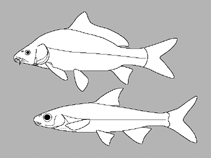
Radios blandos dorsales (total) : 10; Radios blandos anales: 8. This species is distinguished by having a weakly ossified last unbranched dorsal-fin ray and the superior margin of the dorsal fin is straight or slightly concave; differs from all other Italian fluviolacustrine species by having the longest pre-orbital distance 7.9-11.0 %SL; differs from B, samniticus by a lower maximum height 18.8%-24.9% (vs. 20.4%-25.1% SL) and from B. tyberinus, B. plebejus by longer pectoral 17.6%-21.5% (vs. 16.7%-19.8% and . 15.7%-20.4% SL), ventral fins 13.4%-16.3 (vs. 11.0%-15.7 and 11.6%-15.3% SL) and the base of the caudal fin 13.8%-17.4% (vs. 12.1%-14.7% and 12.1%-15.1% SL); differs from B. tyberinus for its longer mouth-operculum distance 20.8%-26.4% (vs. 20.8%-23.9% SL), higher length of both the upper 20.1%-26.0% (vs. 19.1%-23.7% SL) and lower lobes 19.2%-25.6% (vs. 19.5%-23.4% SL) of the caudal fin, a greater height of the first dorsal-fin ossified ray 11.8%-18.4% (vs. 13.7%-16.3% SL), a major quantity of dots on scales and fins and the different dominant colour of anal (orange), dorsal (orange/grey) and ventral (orange) fins; differs from B. plebejus in having fewer scales on 51-65 (vs. 58-71), above 9-14 (vs. 11-15) and under 7-10 (vs. 8-11) the lateral line, ventral fins are composed of 9 rays, A 8; D 10 with straight edge, second ray has a posteriorly serrated edge; the serration teeth are visible to the naked eye only when the specimen is dry; caudal fin forked, with 18 rays; lateral line is straight; dorsal profile slightly convex; body shape rounded in cross-section and tapered. Colouration: in general, silvery, yellowish and greyish-brown on the back, with brown spots composed of small dots irregularly grouped, also present on the flank (Ref. 123793).
Cross section: compressed.
Ciclo vital y comportamiento de apareamiento
Madurez | Reproducción | Puesta | Huevos | Fecundidad | Larva
Lorenzoni, M., A. Carosi, S. Quadroni, V. De Santis, I. Vanetti, G.B. Delmastro and S. Zaccara, 2021. Cryptic diversity within endemic Italian barbels: revalidation and description of new Barbus species (Teleostei: Cyprinidae). J. Fish Biol. 98(5):1433-1449. (Ref. 123793)
Situación en la Lista Roja de la UICN (Ref. 130435: Version 2025-2 (Global))
Amenaza para el ser humano
Harmless
Usos humanos
Herramientas
Informes especiales
Descargar XML
Fuentes de Internet
Estimaciones basadas en modelos
Índice de diversidad filogenética (Referencia
82804): PD
50 = 0.5000 [Uniqueness, from 0.5 = low to 2.0 = high].
Bayesian length-weight: a=0.00794 (0.00367 - 0.01719), b=3.05 (2.88 - 3.22), in cm total length, based on LWR estimates for this Genus-body shape (Ref.
93245).
Nivel trófico (Referencia
69278): 3.1 ±0.4 se; based on size and trophs of closest relatives
Resiliencia (Referencia
120179): Medio, población duplicada en un tiempo mínimo de 1.4-4.4 años (Preliminary K or Fecundity.).
Vulnerabilidad pesquera (Ref.
59153): Low vulnerability (16 of 100).
🛈