>
Blenniiformes (Blennies) >
Labrisomidae (Labrisomids)
Etymology: Malacoctenus: Greek, malakos = soft + Greek, kteis, ktenos = comb (Ref. 45335); zaluari: Named for Ricardo Zaluar Passos Guimarães, an ichthyologist friend who contributed to studies and descriptions of several reef fishes from the Brazilian coast.
Eponymy: Ricardo Zaluar Passos Guimarães of the Laboratório de Biodiversidade de Recursos Pesqueiros, Universidade Federal do Rio de Janeiro, Brazil, is the ‘ichthyologist friend’ of the authors. [...] (Ref. 128868), visit book page.
Milieu: milieu / Klimaatzone / Diepte / verspreidingsgebied
Ecologie
marien rifbewoner; diepte 1 - 15 m (Ref. 123106). Tropical
Southwestern Atlantic: Brazil.
Grootte / Gewicht / Leeftijd
Maturiteit: Lm ? range ? - ? cm
Max length : 4.7 cm SL mannelijk / geslacht onbekend; (Ref. 123106)
Korte beschrijving
Determinatiesleutels | Morfologie | Morfometrie
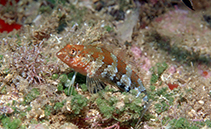
Dorsale stekels (totaal) : 20; Dorsale zachte stralen (totaal) : 11 - 12; Anale stekels: 2; Anale zachte stralen: 19 - 21. This species is distinguished from its southwestern Atlantic congeners by the following set of characters: D XX,11-12 (rarely XXI,10); A II,19-21; pectoral rays 14; length of third pelvic ray contained 2.5 to 3.0 times in second pelvic-fin ray; lateral-line scales 51-53; total nuchal cirri 12-16; presence of pre-dorsal scales and pre-pectoral scales, when present are considerably smaller than scales on body; breast usually fully scaled on males, often naked on females; one pore, rarely absent, extend from preopercular canal onto opercle. Colouration: body with 5-6 saddle-like bars that do not extend on dorsal fin; two thin white bands on upper lip usually extending to snout (Ref. 123106).
Cross section: oval.
Occurs in shallow reefs and tide pools, usually in clear waters where it feeds on small benthic invertebrates (Ref. 123106).
Levenscyclus en paargedrag
Maturiteit | Voortplanting | Paaien | Eieren | Fecunditeit | Larven
Carvalho-Filho, A., I. Sazima, S.M.Q. Lima, D. Almeida, L. Mendes, R.M. Dias, M.R. Britto and J.L. Gasparini, 2020. Review of the genus Malacoctenus (Actinopterygii: Labrisomidae) from the Southwestern Atlantic, with description of two new species. Zootaxa 4819(3):499-520. (Ref. 123106)
Status op de Rode Lijst van het IUCN (Ref. 130435: Version 2025-2 (Global))
Gevaar voor de mens
Harmless
Gebruik door de mens
Tools
Speciale rapporten
Download XML
Internetbronnen
Schattingen op basis van modellen
Fylogenetische diversiteitsindex (Ref.
82804): PD
50 = 0.5000 [Uniqueness, from 0.5 = low to 2.0 = high].
Bayesian length-weight: a=0.00933 (0.00403 - 0.02161), b=3.10 (2.90 - 3.30), in cm total length, based on LWR estimates for this (Sub)family-body shape (Ref.
93245).
Trofisch niveau (Ref.
69278): 3.4 ±0.4 se; based on size and trophs of closest relatives
Kwetsbaarheid van de visserij (Ref.
59153): Low vulnerability (10 of 100).
🛈