Elasmobranchi (squali e razze) (sharks and rays) >
Rhinopristiformes (Shovelnose rays) >
Rhinobatidae (Guitarfishes)
Etymology: andysabini: Named for Andy Sabin for his gracious support of the Lost Sharks project at the Pacific Shark Research Center.
Eponymy: Andrew ‘Andy’ Sabin is the President of Sabin Metal Corporation, and a well-known New York philanthropist committed to species conservation. [...] (Ref. 128868), visit book page.
Ambiente: milieu / zona climatica / distribuzione batimetrica / gamma di distribuzione
Ecologia
marino demersale; distribuzione batimetrica 0 - 80 m (Ref. 124452). Tropical
Western Indian Ocean: Madagascar (probably endemic).
Dimensione / Peso / Età
Maturità: Lm ? range ? - ? cm
Max length : 100.0 cm TL maschio/sesso non determinato; (Ref. 124452)
Breve descrizione
Chiavi di identificazione | Morfologia | Morfometria
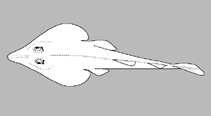
This species is distinguished by the following set of characters: dorsal surface is smooth, no prominent thorns or tubercles, except for enlarged granular denticles partially around orbital rims and irregularly distributed along midline from nape to somewhat anterior to first dorsal-fin origin; absent between dorsal fins and upper caudal fin; snout semi-translucent with elongated bluish-gray spots giving a 'stripe-nosed' appearance, with numerous small bluish-gray spots covering disc and pectoral, pelvic, dorsal, and caudal fins on a brown background with larger, slightly darker, indistinct brown spots covering the tail and fin bases; outer edges of pelvic-fin margins are white, lateral tail folds striped orange and white; ventral surface white, except for a V-shape pattern of faint to dark speckled black spots on snout tip; nasal lamellae 42-48; upper jaw tooth row count ca. 80-87; post-synarcual centra 179-185; total vertebral segments 195-200; total pectoral skeleton radials 64-68 (Ref. 124452).
Cross section: flattened.
Occurs in shallow coastal waters to at least 80 m. All juvenile specimeans ranging in size from 17.7 - 60.3 cm TL, the size at birth ca. 18 cm TL and based on unretained specimens, this species grows to more than 100 cm TL (Ref. 124452).
Ciclo vitale e comportamento di accoppiamento
Maturità | Riproduzione | Deposizione | Uova | Fecondità | Larve
Weigmann, S., D.A. Ebert, B. Séret, 2021. Resolution of the Acroteriobatus leucospilus species complex, with a redescription of A. leucospilus (Norman, 1926) and descriptions of two new western Indian Ocean species of Acroteriobatus (Rhinopristiformes, Rhinobatidae). Marine Biodiversity (2021):51:58. (Ref. 124452)
Stato della Lista Rossa IUCN (Ref. 130435: Version 2025-2 (Global))
Minaccia per l'uomo
Harmless
Usi umani
Strumenti
Rapporti speciali
Scarica XML
Fonti Internet
Stime basate su modelli
Indice di diversità filogenetica (Fonte Biblio.
82804): PD
50 = 0.5010 [Uniqueness, from 0.5 = low to 2.0 = high].
Bayesian length-weight: a=0.00295 (0.00150 - 0.00581), b=3.13 (2.96 - 3.30), in cm total length, based on LWR estimates for this (Sub)family-body shape (Ref.
93245).
Livello trofico (Fonte Biblio.
69278): 3.6 ±0.5 se; based on size and trophs of closest relatives
Resilienza (Fonte Biblio.
120179): Basso, tempo minimo di raddoppiamento della popolazione 4.5 - 14 anni (Preliminary low fecundity).
Vulnerabilità della pesca (Ref.
59153): High vulnerability (60 of 100).
🛈