>
Petromyzontiformes (Lampreys) >
Geotriidae (Southern lampreys)
Etymology: Geotria: Etymology not explained, although three possibilities, all problematical, have been proposed: (1) from the Greek geotragia, “eating of earth-like substances,” referring to how this lamprey, like other lampreys, uses its suctorial mouth to attach itself to submerged rocks and stones, thus creating the impression that it is feeding on the earth (problem: geotragia does not mean “earthy,” as in rocks and minerals, but “products of the earth,” such as grains and vegetables; (2) geo- (Gr.), earth, and atrium (L.), room, referring to this lamprey’s nest, presumably made of stones and pebbles assembled by one or both parents (problem: nest-building, while known in other river lampreys, was probably not known to Gray in 1851 and has not been documented for this species); (3) a variation of #2, proposed by Meagher (2010), referring to its discovery in underground chambers, in which it survives dry periods (problem: G. australis does not, nor does any other lamprey, aestivate, nor did Gray indicate it was discovered underground, although he did speculate whether the pouch was an adaptation to the “long drought of the Australian rivers”). See EthyFish.org for more details (See ETYFish); australis: Latin for southern, referring to South Australia, type locality (See ETYFish).
More on author: Gray.
Taxonomic Remarks
Neira et al., 1988 (Ref. 115329) showed that ammocoetes of an Argentinian population were morphologically distinct from ammocoetes of both Chilean and Australasian (mainland Australia, Tasmania, and New Zealand) populations of the species. Additionally, they stated that adults from Argentina and from South Georgia Island had the cloaca positioned well posterior to the origin of the second dorsal fin rather than aligned immediately under its origin as in Chilean and Australasian populations. Perhaps, therefore, the Argentinian and South Georgian Island population represents a distinct species and this question merits closer scrutiny.
Entorno: milieu / zona climática / rango de profundidad / gama de distribución
Ecología
marino; agua dulce; salobre demersal; anadromo (Ref. 89241). Temperate; 34°S - 55°S, 114°E - 31°W (Ref. 89241)
South Pacific: South Australia, South New Zealand, Chile. South Atlantic: Argentina, Falkland and South Georgia islands.
Tamaño / Peso / Edad
Madurez: Lm ? range ? - ? cm
Max length : 57.0 cm TL macho / no sexado; (Ref. 89241); common length : 47.5 cm SL macho / no sexado; (Ref. 44894)
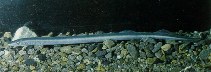
Adult: 7.6-57.0 cm TL; body proportions, as percentage of TL (based on 17 specimens measuring 9.0-57.0 cm TL): 8.3-20.2 prebranchial length, 7.9-11.8 branchial length, 47.6-61.5 trunk length, and 16.1-31.1 tail length; urogenital papilla not prominent in mature adults; trunk myomeres, 70-78; dentition: supraoral lamina with 4 unicuspid teeth (2 pointed central ones flanked by broad lateral flanges), infraoral lamina with 9-15 unicuspid teeth, 8-9 unicuspid endolaterals on each side, 5-7 rows of anterials, first row of anterials with 1-4 unicuspid teeth, 6-8 rows of exolaterals on each side, 1 row of posterials in feeding phase adults with 12 radial plates possibly flanked on each side by 2 unicuspid teeth and in spawning adults about 3 rows (the first consisting of 9 unicuspid teeth), transverse lingual lamina with 3 unicuspid teeth (the median one enlarged in recently metamorphosed individuals), 3 unicuspid teeth (the lateral ones greatly enlarged in feeding individuals and 2 unicuspid teeth in mature individuals), longitudinal lingual laminae each with 4 unicuspid teeth; velar tentacles, 23-40; body coloration (live) in prespawning adults: dorsal surface dark with a pair of longitudinal blue-green stripes running along the dorso-lateral aspect and ventral surface silvery; spawning adults dark blue on dorsal surface and light blue on ventral surface; lateral line neuromasts darkly pigmented; caudal fin shape, rounded; oral fimbriae, 55-65; oral papillae, 16-19 (Ref. 89241).
Body shape (shape guide): eel-like.
Found in mud burrows in upper reaches of coastal streams for the first four years of life until metamorphosis and subsequent downstream migration to the sea (Ref. 44894). Adults inhabit the sea for an undetermined period and are parasitic on other fishes. Migrate upstream which may last for 16 months and spawn in freshwater (Ref. 5154). Adults are often found below weirs and dams during their spawning migration which may take them 60 km or more upstream of the coast (Ref. 44894). Migration mostly takes place in rainy nights when water levels are rising, with temperatures between 12-14.5°C and when there is extensive cloud cover or during the dark phase of the moon (Ref. 5154). Stones with a volume of 144 ml, equivalent in size to a tennis ball, can be transported by adults using their oral disc (Ref. 89241). Sometimes they exit the water by wriggling up the bank to bypass obstacles to migration (Ref. 44894). Adults stop feeding while in freshwater and die shortly after spawning. Maximum length reported to reach 62 cm TL (Ref. 5154). Common length is 45-50 cm SL. Status of abundance decreased due to proliferation of obstacles such as dams and weirs to upstream spawning runs (Ref. 44894). Fecundity, 48,004 to 68,212 eggs/female (Ref. 89241).
In New Zealand, the Maori use the pouched lamprey at the beginning of their upstream migration for human consumption and ceremonial purposes (McDowall, 1990). These are caught using weirs built along river edges or collected by hand as they are making their way up the rocky face of falls. They are then dried for human consumption (Ref. 89241).
Ciclo vital y comportamiento de apareamiento
Madurez | Reproducción | Puesta | Huevos | Fecundidad | Larva
Renaud, C.B., 2011. Lampreys of the world. An annotated and illustrated catalogue of lamprey species known to date. FAO Species Catalogue for Fishery Purposes. No. 5. Rome, FAO. 109 pp. (Ref. 89241)
Situación en la Lista Roja de la UICN (Ref. 130435: Version 2025-2 (Global))
Amenaza para el ser humano
Harmless
Usos humanos
Pesquerías: pesquerías de subsistencia
Herramientas
Informes especiales
Descargar XML
Fuentes de Internet
Estimaciones basadas en modelos
Índice de diversidad filogenética (Referencia
82804): PD
50 = 1.0000 [Uniqueness, from 0.5 = low to 2.0 = high].
Bayesian length-weight: a=0.00102 (0.00046 - 0.00225), b=3.06 (2.88 - 3.24), in cm total length, based on all LWR estimates for this body shape (Ref.
93245).
Nivel trófico (Referencia
69278): 4.5 ±0.80 se; based on food items.
Resiliencia (Referencia
120179): Bajo, población duplicada en un tiempo mínimo de 4.5-14 años (Semelparous species, assuming tm (= tmax) > 4).
Vulnerabilidad pesquera (Ref.
59153): Moderate vulnerability (43 of 100).
🛈
Nutrientes (Ref.
124155): Calcium = 17.7 [4.8, 54.2] mg/100g; Iron = 0.328 [0.134, 1.073] mg/100g; Protein = 3.31 [0.00, 6.99] %; Omega3 = 0.626 [0.289, 1.461] g/100g; Selenium = 14.6 [4.2, 40.9] μg/100g; VitaminA = 20.7 [7.3, 59.9] μg/100g; Zinc = 0.436 [0.218, 0.833] mg/100g (wet weight);