>
Gobiesociformes (Clingfishes) >
Gobiesocidae (Clingfishes and singleslits) > Lepadogastrinae
Etymology: Gouania: From Antoine Gouan, in Montpellier was the author of a "Historia piscium" (Ref. 45335); adriatica: Named for the Adriatic Sea, the type locality of this species; an adjective in the nominative singular (Article 11.9.1.1., ICZN, 1999).
Eponymy: Dr Antoine Gouan (1733–1821) was a French naturalist, a pioneer of Linnaean taxonomy in France, who was born and lived in Montpellier. [...] (Ref. 128868), visit book page.
Meio ambiente: milieu / Zona climática / intervalo de profundidade / faixa de distribuição
Ecologia
marinhas demersal. Temperate
Mediterannean Sea: Adriatic Sea, northern Ionian Sea (Island of Corfu).
Tamanho / Peso / Idade
Maturidade: Lm ? range ? - ? cm
Max length : 4.1 cm SL macho/indeterminado; (Ref. 123696)
Descrição suscinta
Chaves de identificação | Morfologia | Morfometria
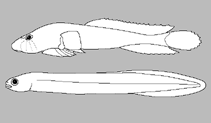
This species is distinguished from its congeners by the following set of characters: dorsal head profile straight line from nape above eye to upper lip tip; posterior angle of jaws extending to between a vertical line drawn through posterior edge of anterior nostril and a vertical line drawn through anterior edge of eye; upper and rounded lower posterior opercular edge pointed; longitudinal infralateral and suborbital transversal rows of superficial neuromasts are placed in the well-defined deep groove; body cross-section behind pectoral fin base half oval with straight ventral side; granules on body shallow and inconspicuous; upper attachment of gill membrane opposite to 5th to 6th pectoral ray; principal caudal-fin rays 12-13; vertical eye diameter 3.4-4.3% of SL; horizontal eye diameter 3.0-3.7% of SL; head length 26.2-30.0% of SL; pectoral-fin length 8.7-11.3% of SL; prepectoral distance 25.1-28.5% of SL; ventral adhesive disc length 15.9-20.1% of SL; caudal-fin length 13.9%-16.4 of SL; low number of vertebrae 35; pharyngeal jaws with ceratobranchial 5 small, having several (about 5) small, conical teeth; nasal bones are club-shaped; eyes with star-like pigmentation around and reduced body pigmentation with no visible stripes (Ref. 123696).
Cross section: oval.
Ciclo de vida ou comportamento de acasalamento
Maturidade | Reprodução | Desova | Ovos | Fecundidade | Larvas
Wagner, M., M. Kovačic and S. Koblmüller, 2021. Unravelling the taxonomy of an interstitial fish radiation: Three new species of Gouania (Teleostei: Gobiesocidae) from the Mediterranean Sea and redescriptions of G. willdenowi and G. pigra. J. Fish Biol. 98(1):64-88. (Ref. 123696)
Status na Lista Vermelha da UICN (Ref. 130435: Version 2025-2 (Global))
Ameaça para os humanos
Harmless
Uso pelos humanos
Ferramentas
Relatórios especiais
Baixar XML
Fontes da internet
Estimativas baseadas em modelos
Índice de diversidade filogenética (Ref.
82804): PD
50 = 0.5312 [Uniqueness, from 0.5 = low to 2.0 = high].
Bayesian length-weight: a=0.00513 (0.00200 - 0.01317), b=3.10 (2.88 - 3.32), in cm total length, based on LWR estimates for this (Sub)family-body shape (Ref.
93245).
Nível Trófico (Ref.
69278): 3.1 ±0.5 se; based on size and trophs of closest relatives
Resiliência (Ref.
120179): Elevada, tempo mínimo de duplicação da população menor que 15 meses (Preliminary K or Fecundity.).
Vulnerabilidade da pesca (Ref.
59153): Low vulnerability (10 of 100).
🛈