>
Galaxiiformes (Southern smelts) >
Galaxiidae (Galaxiids) > Galaxiinae
Etymology: Galaxias: Greek, galaxias, ou = a kind of fish (Ref. 45335); terenasus: Name from Latin 'teres', meaning rounded or smooth, and 'nasus' for nose, referring to the
rounded snout of this species.
Lingkungan: lingkungan / zona iklim / kisaran kedalaman / jangkauan distribusi
Ekologi
; air tawar bentopelagis; nir-ruaya; kisaran kedalaman 0 - 1 m (Ref. 98815). Subtropical
Oceania: Australia.
Ukuran / Berat / umur
Kematangan: Lm ? range ? - ? cm
Max length : 7.0 cm FL jantan/; (Ref. 98815); Berat maksimum terpublikasi: 3.00 g (Ref. 98815)
deskripsi pendek
Kunci identifiaksi (pengenalan) | Morfologi | Morfometrik
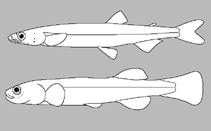
duri punggung lunak (Keseluruhan (total)) : 8 - 11; Sirip dubur lunak: 10 - 13; vertebrata, bertulang belakang: 49 - 53. This species is the most distinctive species and is distinguished from its congeners in the Galaxias olidus complex by the following characters: diminutive size; long anterior nostrils, often visible anterio-laterally from ventral view; distinct body colour pattern and thin fins; low mean total pectoral fin segmented ray count of 13; low mean vertebral count of 51; the dorsal and ventral trunk profiles straight or nearly so; lateral snout profile usually rounded; body depth shallow through pectoral fin base (11.2-14.3 % SL); dorsal midline is usually flattened anteriorly from dorsal fin base; mouth small, usually reaching back to the anterior margin of eye with posterior extent of mouth about 0.4 eye diameter below ventral margin of eye; head and interorbital narrow (49.8-64.0 and 31.4-40.5 % HL, respectively), the head length greater than pelvic-anal distance; eye large (17.5-27.7 % HL and 45.7-73.3 % HD); gape is narrow (26.4-34.4 % HL and 48.7-64.2 % HW); snout, upper and lower jaws are short (17.6-29.8, 24.4-29.9 and 21.2-29.2 % HL, respectively); lower jaw about 95 (82.9-100.0) % length of upper; caudal peduncle is moderately long and longer than length of caudal fin; caudal peduncle flanges are moderately developed but short, usually not reaching to the adpressed anal fin; dorsal fin base short (7.1-11.6 % SL); distance between pelvic and anal fins is short (17.8-24.6 % SL); pelvic fin very short (6.3-11.2 % SL), only about 74.4 % of length of the pectoral fin; no raised lamellae from ventral surface of rays of paired fins; no accessory lateral line; anal fin origin usually under 0.42 distance posteriorly along the dorsal fin base; pyloric caecae 2 thin to moderately thick and long (5.1 % SL); gill rakers are short and stout; no distinct black bars along lateral line (Ref. 98815).
Cross section: oval.
Facultative air-breathing in the genus (Ref. 126274); A freshwater fish that is unable to undertake diadromous migrations. Typically recorded from clear water in slow to moderately flowing creeks to large rivers (1.0-12.0 m average width and 0.1-0.6 m average depth), flowing through light to heavily forested (and shaded) catchments, consisting mainly of pools, glides and riffles with smaller areas of still backwaters. It is also recorded from modified streams in areas almost completely cleared for grazing. Substrate often consists of bedrock, boulder, cobble and coarse sand with smaller amounts of pebble, gravel and silt. Instream cover is typically provided by rock, timber debris, and smaller amounts of aquatic vegetation, leaf litter and bank and vegetation overhang. Average pool depth ranged from 0.2-1.8 m. It is collected at densities ranging from < 0.1-1.5 fish/m2 and found with other native fish species Shortfinned eel, Anguilla reinhardtii (Longfinned Eel), Retropinna sp. (Eastern smelt), and River Blackfish, native decapod crustaceans, Common Freshwater Shrimp, East Gippsland Spiny Crayfish and Variable Spiny Crayfish (Euastacus yanga), and a native bivalve mollusc (Hyridella sp.). Recorded with the alien species Brown Trout, though probably occupies a discrete micro-habitat (Ref. 98815).
Siklus hidup dan perilaku kawin
Kematangan | Reproduksi, perkembang biakan | Pemijahan | telur-telur | Fekunditas | Larva
Raadik, T.A., 2014. Fifteen from one: a revision of the Galaxias olidus Günther, 1866 complex (Teleostei, Galaxiidae) in south-eastern Australia recognises three previously described taxa and describes 12 new species. Zootaxa 3898(1):001-198. (Ref. 98815)
Status IUCN Red List (Ref. 130435: Version 2025-2 (Global))
terancam (EN) (B1ab(i,ii,iii,iv)+2ab(i,ii,iii,iv)); Date assessed: 15 February 2019
ancaman kepada manusia
Harmless
penggunaan manusia
Alat, peralatan
laporan khas
muat turun XML
Sumber internet
Estimasi berdasarkan model
Indeks keanekaragaman filogenetik (Acuan
82804): PD
50 = 0.5000 [Uniqueness, from 0.5 = low to 2.0 = high].
Bayesian length-weight: a=0.00490 (0.00206 - 0.01165), b=3.12 (2.91 - 3.33), in cm total length, based on LWR estimates for this (Sub)family-body shape (Ref.
93245).
Tingkat Trofik (Acuan
69278): 3.1 ±0.4 se; based on size and trophs of closest relatives
Daya lenting (Acuan
120179): Tinggi, Waktu penggandaan populasi minimum kurang dari 15 bulan (Preliminary K or Fecundity.).
Kerentanan Penangkapan Ikan (Ref.
59153): Low vulnerability (10 of 100).
🛈