>
Galaxiiformes (Southern smelts) >
Galaxiidae (Galaxiids) > Galaxiinae
Etymology: Galaxias: Greek, galaxias, ou = a kind of fish (Ref. 45335); tantangara: Named fro its type locality, a small alpine stream, a tributary of the upper Murrumbidgee River draining from Mount Tantangara; noun in apposition.
Milieu: milieu / Klimaatzone / Diepte / verspreidingsgebied
Ecologie
; zoet water benthopelagisch; standvastig; diepte 0 - 1 m (Ref. 98815). Subtropical
Oceania: Australia.
Grootte / Gewicht / Leeftijd
Maturiteit: Lm ? range ? - ? cm
Max length : 10.3 cm FL mannelijk / geslacht onbekend; (Ref. 98815); max. gepubliceerd gewicht: 13.00 g (Ref. 98815)
Korte beschrijving
Determinatiesleutels | Morfologie | Morfometrie
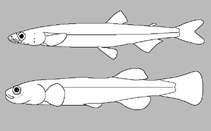
Dorsale zachte stralen (totaal) : 8 - 11; Anale zachte stralen: 10 - 12; Wervels: 53 - 56. This species is distinguished from its congeners within the Galaxias olidus complex by the following characters: low mean total gill raker count of 10; body stocky and deep through vent and pectoral fin base (12.6-15.6 and 14.9-17.9 % SL); deep caudal peduncle (8.5-10.2 % SL); head obtuse to slightly bulbous in lateral profile and moderately deep (41.4-48.2 % HL) but wide (63.4-72.8 % HL); gape wide (40.2-51.0 % HL and 59.6-72.2 % HW); eye profiles often not visible laterally from ventral view; nostrils are short, not visible from ventral view; caudal fin weakly emarginate to truncate, about as long or slightly longer than caudal peduncle, vertical width of expanded rays usually equal to body depth through the pectoral fin base; caudal peduncle flanges are long, reaching more than half distance to anal fin base; anal fin long (16.3 % SL); most posterior extent of mouth 0.8 eye diameter below ventral margin of eye; dorsal midline is usually flattened anteriorly from above or slightly posterior to pectoral fin bases; no raised lamellae from ventral surface of rays of paired fins; anal fin origin usually under 0.73 distance posteriorly along dorsal fin base; pyloric caeca usually 2, occasionally 1, relatively thin and long (4.7 % SL); gill rakers are short to very short; no distinct black bars along lateral line (Ref. 98815).
Cross section: oval.
Facultative air-breathing in the genus (Ref. 126274); A freshwater fish that is unable to undertake diadromous migrations. Recorded from a small (0.8 m average width and 0.1 m in average depth), cold, clear and fast flowing alpine creek, flowing through an open forest of Eucalyptus, low shrubs and tussock grass, and which is often snow covered during winter. Flow consisted predominantly of riffle and glide, with smaller amounts of cascades. Substrate composed of bedrock, boulder, and cobble, with smaller amounts of pebble and gravel, and sections of silt. Instream cover provided mainly by rock and by bank and vegetation overhang, and pools averaged 0.3 m in depth. Recorded at a density of 1.8 fish/m2 and the only native fish so far recorded from within its range (Ref. 98815).
Levenscyclus en paargedrag
Maturiteit | Voortplanting | Paaien | Eieren | Fecunditeit | Larven
Raadik, T.A., 2014. Fifteen from one: a revision of the Galaxias olidus Günther, 1866 complex (Teleostei, Galaxiidae) in south-eastern Australia recognises three previously described taxa and describes 12 new species. Zootaxa 3898(1):001-198. (Ref. 98815)
Status op de Rode Lijst van het IUCN (Ref. 130435: Version 2025-2 (Global))
Gevaar voor de mens
Harmless
Gebruik door de mens
Tools
Speciale rapporten
Download XML
Internetbronnen
Schattingen op basis van modellen
Fylogenetische diversiteitsindex (Ref.
82804): PD
50 = 0.5000 [Uniqueness, from 0.5 = low to 2.0 = high].
Bayesian length-weight: a=0.00490 (0.00206 - 0.01165), b=3.12 (2.91 - 3.33), in cm total length, based on LWR estimates for this (Sub)family-body shape (Ref.
93245).
Trofisch niveau (Ref.
69278): 3.2 ±0.4 se; based on size and trophs of closest relatives
Weerstandsvermogen (Ref.
120179): Hoog, minimale populatieverdubbelingstijd minder dan 15 maanden (Preliminary K or Fecundity.).
Kwetsbaarheid van de visserij (Ref.
59153): Low vulnerability (10 of 100).
🛈