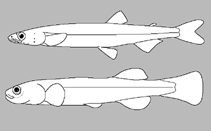
Classificazione / Nomi
Nomi Comuni | Sinonimi | Catalog of Fishes(Genere, Specie) | ITIS | CoL | WoRMS | Cloffa
>
Galaxiiformes (Southern smelts) >
Galaxiidae (Galaxiids) > Galaxiinae
Etymology: Galaxias: Greek, galaxias, ou = a kind of fish (Ref. 45335); oliros: Name from the combination of the first three letters of the following species: Galaxias olidus and Galaxias rostratus. first used as a field code for what appeared to be a distinct
morphological form intermediate between, and sharing morphological characteristics with, both taxa, especially the juvenile to young adult stages.
Ambiente: milieu / zona climatica / distribuzione batimetrica / gamma di distribuzione
Ecologia
; acqua dolce benthopelagico; non migratori; distribuzione batimetrica 0 - 1 m (Ref. 98815). Subtropical
Oceania: Australia.
Dimensione / Peso / Età
Maturità: Lm ? range ? - ? cm
Max length : 13.3 cm FL maschio/sesso non determinato; (Ref. 98815); peso massimo pubblicato: 33.00 g (Ref. 98815)
Breve descrizione
Chiavi di identificazione | Morfologia | Morfometria
Raggi dorsali molli (totale) : 7 - 11; Raggi anali molli: 9 - 14; Vertebre: 50 - 56. This species is distinguished from is congeners within the Galaxias olidus complex by the following characters: trunk usually laterally compressed posteriorly from about above the pelvic fin base; caudal fin emarginate to weakly forked; often 12 segmented rays in anal fin (range 9-14), always more than in the dorsal fin, which usually has about 9 segmented rays; anal fin base length long (9.8-14.1 % SL) and that of dorsal fin short (7.4-10.8 % SL), anal fin long (14.3-19.7 % SL); caudal peduncle somewhat shallow (6.5-9.0 % SL); pelvic fins moderately large, about 91 % of length of pectoral fins; lateral profile of head is slightly to moderately wedge-shaped and snout rounded; inter-orbital wide (36.0-46.4 % HL) and eye moderately large (16.4-23.9 % HL); nostrils are moderate in length, usually not visible from ventral view; anterior tip of upper lip level with about 0.6 eye diameter above ventral margin of eye; raised lamellae usually absent from ventral surface of rays of paired fins, very occasionally present but weakly developed; anal fin origin usually under 0.47 distance posteriorly along dorsal fin base, often much less; usually with a single, short (1.2 % SL) pyloric caecum, but mostly absent; gill rakers variable, of moderate length to long and stout to thin; distinct body pattern, particularly on the sides, gill cover often with a large turquoise or gold patch and belly often distinctly silvery or white; the distinct black bars along lateral line are usually absent, although occasionally some individuals with darker mid-lateral dark brownish blotches between the pectoral and pelvic fin bases, or a single, to a series of, very narrow and short faint brown to greyish dark brown mid-lateral bars anteriorly behind the pectoral fin base (Ref. 98815).
Cross section: oval.
Facultative air-breathing in the genus (Ref. 126274); A freshwater fish that is unable to undertake diadromous migrations. Generally found at low to moderate elevations (lowland to foothill reaches) in different stream types, ranging from slower-flowing, clear to turbid, medium to larger rivers (4-20 m average width), gently or moderately fast flowing smaller creeks (0.5-4.0 m average width), also in anabranches, billabongs and some wetlands, including disconnected pools in drying water courses. It is recorded from shallow riffle areas along the edge of pools as juveniles, to deeper (0.1- >1.2 m average depth), more open water habitats in pools as adults, although also usually in glides. Often found among dense aquatic vegetation and timber debris, occasionally in the open in midwater or just under the surface. Recorded often at densities up to 0.7-1.6 fish/m2, but can be very abundant in swamps, billabongs and isolated pools (up to 8.0 fish/m2). Collected with a diverse range of fish and decapod crustacea, commonly with Galaxias olidus, Galaxias arcanus, Gadopsis marmoratus (River blackfish), Nannoperca australis (Southern Pygmy Perch), Retropinna sp. (Australian Smelt), Philypnodon grandiceps (Flatheaded Gudgeon), Common Freshwater Shrimp and Common Yabby. It appears to have high physico-chemical tolerance as recorded from isolated pools with high water turbidity or salinity levels (e.g. Wimmera and Glenelg river systems), or stagnant, refuge pools with high loads of dissolved organic carbon from leachates of Eucalyptus leaves (e.g. Marne River) and upper Avoca River system. It has been found to be infected with the parasitic copepod Lernaea cyprinoides, and can be lightly to heavily infected with small grey to black cysts, possibly trematode metacercariae, embedded in the skin of the head or trunk, or in the fins. A small number of fish were recorded with a short, thin, white worm, coiled and pointed at both ends, from amongst fat deposits around the stomach in the body cavity, others with small ulcers on the body. Deformities recorded of fins (dorsal, pectoral, and pelvic), jaws and posterior margin of the gill cover, and some with curvature of the spine (Ref. 98815).
Ciclo vitale e comportamento di accoppiamento
Maturità | Riproduzione | Deposizione | Uova | Fecondità | Larve
Raadik, T.A., 2014. Fifteen from one: a revision of the Galaxias olidus Günther, 1866 complex (Teleostei, Galaxiidae) in south-eastern Australia recognises three previously described taxa and describes 12 new species. Zootaxa 3898(1):001-198. (Ref. 98815)
Stato della Lista Rossa IUCN (Ref. 130435: Version 2025-2 (Global))
Minaccia per l'uomo
Harmless
Usi umani
Strumenti
Rapporti speciali
Scarica XML
Fonti Internet
Stime basate su modelli
Indice di diversità filogenetica (Fonte Biblio.
82804): PD
50 = 0.5000 [Uniqueness, from 0.5 = low to 2.0 = high].
Bayesian length-weight: a=0.00490 (0.00206 - 0.01165), b=3.12 (2.91 - 3.33), in cm total length, based on LWR estimates for this (Sub)family-body shape (Ref.
93245).
Livello trofico (Fonte Biblio.
69278): 3.2 ±0.5 se; based on size and trophs of closest relatives
Resilienza (Fonte Biblio.
120179): Alto, tempo minimo di raddoppiamento della popolazione meno di 15 mesi (Preliminary K or Fecundity.).
Vulnerabilità della pesca (Ref.
59153): Low vulnerability (10 of 100).
🛈