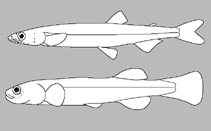
>
Galaxiiformes (Southern smelts) >
Galaxiidae (Galaxiids) > Galaxiinae
Etymology: Galaxias: Greek, galaxias, ou = a kind of fish (Ref. 45335); mungadhan: Name from the language of the Gunai/Kurnai indigenous nation (traditional inhabitants of the Gippsland region of Victoria): ‘munga’ meaning from, and ‘dhan’ meaning frost or snow, referring to its distribution at high elevations on the Dargo High Plains which are usually covered by snow during winter.
Ambiente: milieu / zona climática / intervalo de profundidade / gama de distribuição
Ecologia
; Água doce bentopelágico; não migratória; intervalo de profundidade 0 - 1 m (Ref. 98815). Subtropical
Oceania: Australia.
Tamanho / Peso / Idade
Maturidade: Lm ? range ? - ? cm
Max length : 11.0 cm FL macho/indeterminado; (Ref. 98815); peso máx. Publicado: 11.00 g (Ref. 98815)
Descrição breve
Chaves de identificação | Morfologia | Morfometria
Raios dorsais moles (total) : 9 - 11; Raios anais moles: 9 - 11; Vértebras: 55. This species is distinguished from its congeners within the Galaxias olidus complex by the following characters: a long distance between pelvic and anal fin bases (22.4-27.7 % SL); head shallow (30.0-42.6 % HL), post-orbital head length long (54.7-62.4 % HL); inter-orbital narrow (35.1-40.4 % HL); nostrils are of moderate length, not visible from ventral view; dorsal and anal fin origins are set far back along trunk (70.5-74.5 and 74.4-79.9 % SL, respectively); body depth through pectoral fin base greater (121.2 % SL) than that through vent; anal fin base is short (9.0-10.7 % SL), usually shorter than dorsal fin base; dorsal fin is short (13-15 % SL), anal fin moderately short (13.2-15.6 % SL); lower jaw length is much shorter (67.8-89.0 %) than width of gape; expanded rays of caudal fin equal to or less than body depth through pectoral fin base; dorsal midline usually flattened anteriorly from above or slightly posterior to pectoral fin bases; often 10-segmented anal fin rays; posterior extent of mouth about 0.8 eye diameter below ventral margin of eye; pyloric caecae may be present or absent, if present, as a single, wide and blunt, short (0.7 % SL) caecum; gill rakers are short and stout; anal fin origin usually under 0.61 distance posteriorly along dorsal fin base; no distinct black bars along lateral line; and, usually dark chocolate brown overall when alive (Ref. 98815).
Cross section: oval.
Facultative air-breathing in the genus (Ref. 126274); A freshwater fish that is unable to undertake diadromous migrations. Recorded from a small (0.5-1.3 m average width, 0.05-0.40 m average depth), cool, clear, alpine creek, flowing through a grassy plain, consisting predominantly of riffles and pools, and with very little shading except that provided by grasses. During winter this catchment is often covered by snow for varying periods of time. Substrate consisted mainly of bedrock with some loose boulders, with smaller amounts of pebble, gravel, sand and clay and overlain in backwaters by silt. Instream cover provided by rock and by bank and vegetation (alpine grasses) overhang, and pools averaged 0.5 m in depth. Recorded at densities of 4.2-6.4 fish/m2 and is the only native fish species so far recorded from within its range and the only species of Galaxias found within its current restricted range. Historically have been found with Galaxias olidus, which is present nearby. Galaxias brevipinnis, Galaxias maculatus and Galaxias truttaceus are found farther downstream in the Dargo River system and their ranges may also have historically overlapped with this species. Alien trout have substantially altered distributional patterns in the last 150 years and fragmented and reduced the distributional range of galaxiids and their populations (Ref. 98815).
Ciclo de vida e comportamento de acasalamento
Maturidade | Reprodução | Desova | Ovos | Fecundidade | Larvas
Raadik, T.A., 2014. Fifteen from one: a revision of the Galaxias olidus Günther, 1866 complex (Teleostei, Galaxiidae) in south-eastern Australia recognises three previously described taxa and describes 12 new species. Zootaxa 3898(1):001-198. (Ref. 98815)
Categoria na Lista Vermelha da IUCN (Ref. 130435: Version 2025-2 (Global))
Ameaça para o homem
Harmless
Utilização humana
Ferramentas
Relatórios especiais
Descarregue XML
Fontes da internet
Estimativas baseadas em modelos
Índice de diversidade filogenética (Ref.
82804): PD
50 = 0.5000 [Uniqueness, from 0.5 = low to 2.0 = high].
Bayesian length-weight: a=0.00490 (0.00206 - 0.01165), b=3.12 (2.91 - 3.33), in cm total length, based on LWR estimates for this (Sub)family-body shape (Ref.
93245).
Nível Trófico (Ref.
69278): 3.2 ±0.5 se; based on size and trophs of closest relatives
Resiliência (Ref.
120179): Elevada, tempo mínimo de duplicação da população menor que 15 meses (Preliminary K or Fecundity.).
Vulnerabilidade da pesca (Ref.
59153): Low vulnerability (10 of 100).
🛈