>
Galaxiiformes (Southern smelts) >
Galaxiidae (Galaxiids) > Galaxiinae
Etymology: Galaxias: Greek, galaxias, ou = a kind of fish (Ref. 45335); longifundus: Name from Latin 'longus' for long and 'fundus' for base or bottom, referring to the relatively long dorsal and anal fin bases of this species when compared with its congeners of the Galaxias olidus complex.
Meio ambiente: milieu / Zona climática / intervalo de profundidade / faixa de distribuição
Ecologia
; Água doce bentopelágico; não migratória; intervalo de profundidade 0 - 1 m (Ref. 98815). Subtropical
Oceania: Australia.
Tamanho / Peso / Idade
Maturidade: Lm ? range ? - ? cm
Max length : 9.7 cm FL macho/indeterminado; (Ref. 98815); peso máx. publicado: 11.00 g (Ref. 98815)
Descrição suscinta
Chaves de identificação | Morfologia | Morfometria
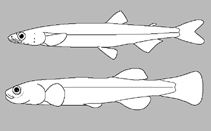
Raios dorsais (total) : 9 - 11; Raios anais : 9 - 11; Vértebras: 52 - 54. This species is distinguished from all other species within the Galaxias olidus complex by the following characters: long dorsal and anal fin bases (11.2-12.4 and 10.6-12.1 % SL, respectively); long dorsal and anal fins, with the dorsal fin and base lengths longer than that of anal fin; eye relatively small (14.9-18.4 % HL); gape narrow (50.6-63.7 % HW); body depth through pectoral fin base is only slightly greater (108.7 %) than depth through vent; nostrils are moderately long, usually just visible anterio-laterally from ventral view; eyes are well below dorsal head profile; most posterior extent of the mouth usually 0.9 eye diameter below ventral margin of eye; caudal peduncle flanges are distinctive, long and also extend along outer rays onto caudal fin; caudal fin emarginate to almost truncate; usually with 10 segmented anal fin rays; total gill rakers on first arch 11; gill rakers moderately long; pyloric caecae often 1, sometimes 2, thin and pointed of moderate length (2.2 % SL), very occasionally absent; anal fin origin usually under 0.58 distance posteriorly along dorsal fin base; no black bars along lateral line (Ref. 98815).
Cross section: oval.
Facultative air-breathing in the genus (Ref. 126274); Recorded from a moderately shaded, gently flowing, small and shallow (2.0 m average width and 0.5 m average depth) creek, consisting mainly of pools with smaller areas of shallow riffle (0.05 m average depth). The substrate consisted of boulder, cobble and pebble, with small amounts of gravel, sand and clay. Instream cover was provided mainly by rock with smaller amounts of logs, branches and bank/vegetation overhang, and pools averaged 0.9 m (0.6-1.1 m) in depth. In 2002, reported density was 0.27 fish/m2 and in 2012 0.004-0.01 fish/m2. Collected with the native species Shortfinned Eel, Broadfinned Galaxias, Gippsland Spiny Crayfish, a species of burrowing crayfish (Engaeus sp.) and Common Freshwater Shrimp (Ref. 98815).
Ciclo de vida ou comportamento de acasalamento
Maturidade | Reprodução | Desova | Ovos | Fecundidade | Larvas
Raadik, T.A., 2014. Fifteen from one: a revision of the Galaxias olidus Günther, 1866 complex (Teleostei, Galaxiidae) in south-eastern Australia recognises three previously described taxa and describes 12 new species. Zootaxa 3898(1):001-198. (Ref. 98815)
Status na Lista Vermelha da UICN (Ref. 130435: Version 2025-2 (Global))
Ameaça para os humanos
Harmless
Uso pelos humanos
Ferramentas
Relatórios especiais
Baixar XML
Fontes da internet
Estimativas baseadas em modelos
Índice de diversidade filogenética (Ref.
82804): PD
50 = 0.5000 [Uniqueness, from 0.5 = low to 2.0 = high].
Bayesian length-weight: a=0.00490 (0.00206 - 0.01165), b=3.12 (2.91 - 3.33), in cm total length, based on LWR estimates for this (Sub)family-body shape (Ref.
93245).
Nível Trófico (Ref.
69278): 3.2 ±0.4 se; based on size and trophs of closest relatives
Resiliência (Ref.
120179): Elevada, tempo mínimo de duplicação da população menor que 15 meses (Preliminary K or Fecundity.).
Vulnerabilidade da pesca (Ref.
59153): Low vulnerability (10 of 100).
🛈