Classification / Noms
Noms communs | Synonymes | Catalog of Fishes(Genre, Espèce) | ITIS | CoL | WoRMS | Cloffa
>
Cyprinodontiformes (Rivulines, killifishes and live bearers) >
Fluviphylacidae (American lampeyes)
Etymology: Fluviphylax: Latin, fluvius = river + Greek,phylax, -akos = guardian (Ref. 45335); gouldingi: Named for the American ichthyologist Michael Goulding.
Eponymy: Dr Michael Goulding (d: 1950) is a conservation ecologist and scientist at the University of Florida and with the Amazon Conservation Alliance with which he has worked for over 30 years. [...] (Ref. 128868), visit book page.
Environnement : milieu / zone climatique / profondeur / gamme de distribution
Écologie
; eau douce benthopélagique; profondeur 0 - 1 m (Ref. 123788). Tropical
South America: Brazil.
Taille / Poids / Âge
Maturité: Lm ? range ? - ? cm
Max length : 1.4 cm SL mâle / non sexé; (Ref. 123788); 1.4 cm SL (female)
Description synthétique
Clés d'identification | Morphologie | Morphométrie
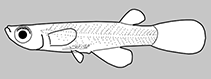
Rayons mous dorsaux (Total) : 5 - 6; Rayons mous anaux: 7 - 8; Vertèbres: 27 - 28. This species is distinguished from its congeners by having a sharp ventral process on the opercle (vs. absent); subopercle narrow (vs. wide); interopercle narrow (vs. wide); filamentous second pelvic-fin ray (vs. not filamentous); all cephalic lateral line system opened in males and females (vs. closed); no mesethemoid (vs. present); presence of an orange bright blotch on the preorbital region of both males and females (vs. absent); similar to F. wallacei and differs from all other congeners by having a slender retroarticular (vs. deep); opercle triangular-shaped (vs. scale-shaped); males with an orange colouration on the posterior region of the pectoral fin (vs. hyaline); head neuromasts not placed inside shallow groves (vs. in shallow grooves). Other characters not unique but useful to identify tis species include: second and fourth pharyngobranchial tooth plates not enlarged (vs. enlarged); no teeth on second pharyngobranchial plate (vs. present); ventral process of posttemporal short (vs. long); with rostral cartilage (vs. absent); anterodorsal process of opercle non-existent (vs. present); an elongate and pointed anal fin reaching vertical to dorsal-fin tip (vs. short and rounded) (Ref. 123788).
Collected close to the deadwood in a shallow, slow flowing, high transparency black-water stream, about 30-50 cm deep with dense vegetation. In the small stream they were found in small shoals of about 3-5 individuals swimming near the surface, while in the Lago Tiburiari this species formed larger shoals of about 20 individuals. Found sympatrically was the miniature scoloplacid, Scoloplax dolicholophia (Ref. 123788),
Cycle de vie et comportement reproducteur
Maturité | Reproduction | Frai | Œufs | Fécondité | Larves
Bragança, P.H.N., 2018. Fluviphylax gouldingi and F. wallacei, two new miniature killifishes from the middle and upper Rio Negro drainage, Brazilian Amazon (Teleostei, Cyprinodontiformes, Cyprinodontoidei). Spixiana (München) 41(1):133-146. [German translation appeared in DKG-Journal, 52(1):Feb. 2020:1-18.] (Ref. 123788)
Statut dans la liste rouge de l'IUCN (Ref. 130435: Version 2025-2 (Global))
Menace pour l'homme
Harmless
Utilisations par l'homme
Pêcheries: sans intérêt
Outils
Articles particuliers
Télécharger en XML
Sources Internet
Estimations basées sur des modèles
Indice de diversité phylogénétique (Réf.
82804): PD
50 = 0.5078 [Uniqueness, from 0.5 = low to 2.0 = high].
Bayesian length-weight: a=0.00537 (0.00207 - 0.01392), b=3.09 (2.87 - 3.31), in cm total length, based on LWR estimates for this (Sub)family-body shape (Ref.
93245).
Niveau trophique (Réf.
69278): 3.0 ±0.4 se; based on size and trophs of closest relatives
Vulnérabilité de la pêche (Ref.
59153): Low vulnerability (10 of 100).
🛈