Klassifizierung / Names
Namen | Synonyme | Catalog of Fishes(Gattung, Arten) | ITIS | CoL | WoRMS | Cloffa
>
Cichliformes (Cichlids, convict blennies) >
Cichlidae (Cichlids) > Cichlinae
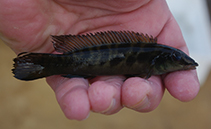
Etymology: Teleocichla: Greek, tele, telos = perfect + Greek, kichle = wrasse (Ref. 45335); preta: Adjective in Portuguese meaning black; refers to the diagnostic dark overall colouration of the body and to the previous denominations for the species in the scientific and aquarium literature, as well as among fishermen of the Rio Xingu. Noun in apposition.
Umwelt: Milieu / Klimazone / Tiefenbereich / Verbreitungsgebiet
Ökologie
; süßwasser benthopelagisch. Tropical; 0°S - 10°S, 55°W - 50°W (Ref. 108975)
South America: Brazil, Amazon basin, Rios Xingu and Iriri (Ref. 108975).
Größe / Gewicht / Alter
Geschlechtsreife: Lm ? range ? - ? cm
Max length : 24.5 cm TL Männchen/unbestimmt; (Ref. 126097); max. veröff. Gewicht: 178.00 g (Ref. 126097)
Kurzbeschreibung
Bestimmungsschlüssel | Morphologie | Morphometrie
Rückenflossenstacheln (insgesamt) : 21 - 23; Rückenflossenweichstrahlen (insgesamt) : 7 - 10; Afterflossenstacheln: 3; Afterflossenweichstrahlen: 8 - 9; Wirbelzahl: 35 - 37. This species is distinguished from all its congeners by the following characters: a unique blackish (in live specimens) or dark brown (preserved specimens) general body colouration, which masks the faint vertical bars or a zig-zag pattern of blotches on the flanks; a deeper and posteriorly strongly compressed caudal peduncle, its depth 11.7-14.9 % SL, mean 13% (vs. < 10.9% SL); a deeper body, its depth 17.9-21.6% SL, mean 19.9% (vs. less or equal to 18.3%); stout lower pharyngeal tooth plate bearing molariform teeth on its median area (vs. conical); with maximum size 12.13 cm SL (vs. 8.15 cm SL in the largest known specimen of prionogenys and 8.78 cm SL in wajapi); differs from centrarchus and wajapi by having 3 anal-fin spines (vs. 4); differs from monogramma and centisquama by having the anterior and posterior branches of the lateral line separated by 2 horizontal scale rows (vs. lateral line continuous); differs from gephyrogramma by the absence of a caudal-fin blotch (vs. present, rounded and conspicuous); differs from cinderella by the absence of small dark spots scattered on flanks (vs. presence at least in specimens up to 6.0 cm SL) and by the absence of filamentous dorsal-fin prolongation in sexually dimorphic males (Ref. 108975).
Cross section: compressed.
In moderate to fast, shallow rapids, with clear water and the riverbed composed mainly of large rocks and little accumulated sediment. Feeds predominantly on of caddisfly larvae (Trichoptera) and other hard-shelled invertebrates (gastropods and bivalves), as well as midges (Diptera: Chironomidae) and mayfly larvae (Ephemeroptera) (Ref. 108975).
Lebenszyklus und Paarungsverhalten
Geschlechtsreife | Fortpflanzung | Ablaichen | Eier | Fruchtbarkeit | Larven
Varella, H.R., J. Zuanon, S.O. Kullander and H. López-Fernández, 2016. Teleocichla preta, a new species of cichlid from the Rio Xingu basin in Brazil (Teleostei: Cichlidae). J. Fish Biol. 89(3):1551-1569. (Ref. 108975)
IUCN Rote Liste Status (Ref. 130435: Version 2025-2 (Global))
Bedrohung für Menschen
Harmless
Nutzung durch Menschen
Tools
Zusatzinformationen
Download XML
Internet Quellen
Schätzungen auf der Grundlage von Modellen
Phylogenetischer Diversitätsindex (Ref.
82804): PD
50 = 0.5020 [Uniqueness, from 0.5 = low to 2.0 = high].
Bayesian length-weight: a=0.00794 (0.00430 - 0.01467), b=3.10 (2.94 - 3.26), in cm total length, based on LWR estimates for this species & (Sub)family-body (Ref.
93245).
Trophische Ebene (Ref.
69278): 3.3 ±0.5 se; based on size and trophs of closest relatives
Widerstandsfähigkeit (Ref.
120179): hoch, Verdopplung der Population dauert weniger als 15 Monate. (Preliminary K or Fecundity.).
Anfälligkeit der Fischerei (Ref.
59153): Low vulnerability (15 of 100).
🛈