分類 / 名前
共通名の | 類義語 | Catalog of Fishes(部類, 種) | ITIS | CoL | WoRMS | Cloffa
>
Cichliformes (Cichlids, convict blennies) >
Cichlidae (Cichlids) > Geophaginae
Etymology: Gymnogeophagus: Greek, gymnos = naked + Greek, gea = the earth + Greek, phaegein, to eat (Ref. 45335); taroba: Name from Tarobá, a warrior, referring to a legend of the Kaingang people; noun in apposition.
Eponymy: Tarobá was a warrior in a legend of the Kaingang people, who were the first inhabitants of the present-day province of Misiones in Argentina, particularly the Río Iguazú basin, above the falls, where these species occur. [...] (Ref. 128868), visit book page.
環境:環境 / 気候帯 / 深さの範囲 / 分布範囲
生態学
; 新鮮な水 底生の漂泳性. Tropical
South America: Argentina.
サイズ / 重さ / 年齢
成熟: Lm ? range ? - ? cm
Max length : 9.1 cm SL オス/雌雄の選別がない; (Ref. 123557)
簡単な記述
検索表 | 形態学 | 形態計測学
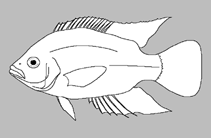
背面の脊椎 (合計) : 12 - 14; 背鰭 (合計) : 9 - 11; 肛門の骨: 3; 臀鰭: 7 - 10; 脊つい: 26 - 27. This species is distinguished from all its congeners in the gymnogenys group by having 23-25 E1 scales and the absence in adult males of a well-developed adipose hump. It is most easily distinguished from all species in the G. rhabdotus group (with terrapurpura, meridionalis, setequedas, che) by the pigmentation of the dorsal fin, where the spiny section of the dorsal fin lacks any markings (vs. various types of markings) and the soft section has long and thin whitish light blue lines parallel to rays (vs. wide stripes rhabdotus, a combination of roundish spots at the base and stripes of various length and width distally meridionalis, terrapurpura, setequedas, che; the anal fin also has long and thin whitish light blue lines parallel to rays (vs. spotted in terrapurpura and a combination of roundish spots at the base and stripes of various length and width distally in rhabdotus, meridionalis, setequedas, che, however, in setequedas only the posterior half of the anal fin has markings, while the anterior half has none. Within the G. setequedas group, G. taroba differs by having opalescent lines on posterior part of body and on caudal peduncle narrow, starting behind the midlateral blotch and are not found on the dorsum above the upper lateral line (vs. wide, beginning in front of the midlateral blotch and are found on the dorsum in setequedas, che); the midlateral blotch usually conspicuous and dominant, as in che (vs. inconspicuous in setequedas); opalescent markings on head large and dominant, present on opercular series, as in che (vs. small and inconspicuous, usually absent from opercular series in setequedas); body scales or their centers are grey, as in setequedas (vs. scale centers on at least the posterior part of body and caudal peduncle distinctly reddish-brown in che); the caudal fin with best developed white longitudinal lines and most pronounced difference between a yellow to orange central portion of the fin and red dorsal and ventral margins; it differs further from setequedas by having a longer snout, 44.4-53.7 %HL (vs. 30.8-44.7) and from che by having a deeper body, 40.2-46.1 % of SL (vs. 37.3-40.7) (Ref. 123557).
Cross section: compressed.
This species is mainly in pools and lentic stretches of smaller streams with muddy or sandy bottoms. Some specimens were collected in pools between rock-gardens in the Iguazú main channel (Pasarela a Garganta del Diablo and pasarela a salto San Martín) and are ecologically very similar to the small tributary streams with similar stony substrates and muddy bottoms (Ref. 123557).
ライフサイクルと交尾行動
成熟 | 繁殖 | 放精 | 卵 | 生産力 | 幼生
Casciotta, J.R., A.E. Almirón, L. Piálek and O. Říčan, 2017. Gymnogeophagus taroba (Teleostei : Cichlidae ), a new species from the río Iguazú basin, Misiones, Argentina. Historia Natural 7(2):5-22. (Ref. 123557)
IUCNのレッドリストの状況は (Ref. 130435: Version 2025-2 (Global))
人間の用途
用具
特記事項
XMLをダウンロードして下さい
インターネットの情報源
モデルに基づく推定値
系統多様性指数 (参照
82804): PD
50 = 0.5000 [Uniqueness, from 0.5 = low to 2.0 = high].
Bayesian length-weight: a=0.01995 (0.00918 - 0.04336), b=3.01 (2.83 - 3.19), in cm total length, based on LWR estimates for this (Sub)family-body shape (Ref.
93245).
栄養段階 (参照
69278): 3.3 ±0.5 se; based on size and trophs of closest relatives
回復力 (参照
120179): 高い, 15か月以下の倍増期間の最小個体群 (Preliminary K or Fecundity.).
漁業の脆弱性 (Ref.
59153): Low vulnerability (10 of 100).
🛈