Klassifizierung / Names
Namen | Synonyme | Catalog of Fishes(Gattung, Arten) | ITIS | CoL | WoRMS | Cloffa
>
Lophiiformes (Anglerfishes) >
Histiophrynidae (Starfingered frogfishes)
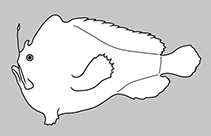
Etymology: Porophryne: Name from the Greek 'poro' meaning to bear pores, referring to the naked, black, ‘‘osculum-like’’ spots on the head and body of most specimens, as well as its primary microhabitat within sponge (Porifera) beds; and 'phryne' for toad, a suffix commonly applied to lophiiform generic names; erythrodactylus: Name from Greek erythros meaning red, and dactylus for fingers; referring to the conspicuous red pigmentation on the tips of the pectoral-fin rays as well as along the distal margins of some or all other fins.
Umwelt: Milieu / Klimazone / Tiefenbereich / Verbreitungsgebiet
Ökologie
seewasser demersal; tiefenbereich 6 - 24 m (Ref. 97600). Subtropical
Western Pacific: Australia.
Größe / Gewicht / Alter
Geschlechtsreife: Lm ? range ? - ? cm
Max length : 7.4 cm SL Männchen/unbestimmt; (Ref. 97600)
This species usually found in subtidal rocky-reef habitat dominated by small filamentous and foliose algae Zonaria, Corallina, Amphiroa, and Laurencia (often with some Sargassum spp.), a few scattered larger seaweeds, including Ecklonia radiata and Sargassum spp., and large patches of filamentous or foliose algae. Vertical or sloping walls on the deep edge of nearby reefs are inhabited by ascidians, corals, and sponges, the latter including Spongia sp., Tedania anhelans, Ephydatia fluviatilis, Darwinella australiensis, Chondrilla australiensis, Mycale australis, and Holopsamma laminaefavosa. It is most often found closely associated with small sponges, blending in with the gray coloration of Psammocinia sp. or the red or yellow coloration of Darwinella sp., or nestled next to fan-shaped Echinoclathria leporina. The black ‘‘osculum-like’’ spots typically present on gray color morphs of the new species presumably aid in the mimicry of sponges as well (Ref. 97600).
Lebenszyklus und Paarungsverhalten
Geschlechtsreife | Fortpflanzung | Ablaichen | Eier | Fruchtbarkeit | Larven
Arnold, R.J., R. Harcourt and T.W. Pietsch, 2014. A new genus and species of the frogfish family Antennariidae (Teleostei: Lophiiformes: Antennarioidei) from New South Wales, Australia, with a diagnosis and key to the genera of the Histiophryninae. Copeia 14(3):534-539. (Ref. 97600)
IUCN Rote Liste Status (Ref. 130435: Version 2025-2 (Global))
Bedrohung für Menschen
Harmless
Nutzung durch Menschen
Fischereien: nicht kommerziell
Tools
Zusatzinformationen
Download XML
Internet Quellen
Schätzungen auf der Grundlage von Modellen
Phylogenetischer Diversitätsindex (Ref.
82804): PD
50 = 1.0000 [Uniqueness, from 0.5 = low to 2.0 = high].
Bayesian length-weight: a=0.01000 (0.00244 - 0.04107), b=3.04 (2.81 - 3.27), in cm total length, based on all LWR estimates for this body shape (Ref.
93245).
Trophische Ebene (Ref.
69278): 3.6 ±0.5 se; based on size and trophs of closest relatives
Anfälligkeit der Fischerei (Ref.
59153): Low vulnerability (10 of 100).
🛈