>
Characiformes (Characins) >
Anostomidae (Headstanders)
Etymology: Leporinus: Latin, lepus, leporis = rabbit (Ref. 45335); villasboasorum: Named for Orlando, Cláudio and Leonardo Villas-Bôas; noun in the genitive case.
Entorno: milieu / zona climática / rango de profundidad / gama de distribución
Ecología
; agua dulce bentopelágico. Tropical
South America: Brazil (Xingu and Tapajós rivers).
Tamaño / Peso / Edad
Madurez: Lm ? range ? - ? cm
Max length : 12.8 cm SL macho / no sexado; (Ref. 119688)
Descripción breve
Claves de identificación | Morfología | Morfometría
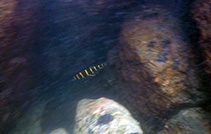
This species is distinguished from all its congeners except desmotes, jatuncochi, enyae by having a laterally compressed, elongate (more than twice as long as the second dentary tooth) tusk-like symphyseal dentary teeth (vs. the more truncate conical or incisiform teeth; less than twice as long as the second dentary tooth, typical of other congeners; differs from its congeners except bleheri, desmotes, enyae, jatuncochi, yophorus by the color pattern on the head and trunk consisting of 9 dark bars, some of which fork dorsally or ventrally, the fifth of which continues onto the dorsal and pelvic fins, (vs. various other color patterns in the approximately 90 other described species of Leporinus; differs most easily from jatuncochi and some specimens of desmotes by having 16 circumpeduncular scales (vs. 14); differs from enyae by having the dark bar anterior to the dorsal fin well-divided dorsally (vs. bar undivided or barely divided dorsally); similar in meristics and coloration to desmotes by having 16 circumpeduncular scales, but differs morphometrically with the most diagnostic are the shallower body depth of villasboasorum, 23.0-24.9% SL (vs. 25.1-28.9% SL) and the shorter distance from the pelvic-fin origin to adipose-fin origin 36.3-38.6% SL (vs. 38.5-43.4% SL) with the regression lines differing greatly between the species (Ref. 119688).
Cross section: compressed.
Ciclo vital y comportamiento de apareamiento
Madurez | Reproducción | Puesta | Huevos | Fecundidad | Larva
Burns, M.D., M. Chatfield, J.L.O. Birindelli and B.L. Sidlauskas, 2017. Systematic assessment of the Leporinus desmotes species complex, with a description of two new species. Neotropical Ichthyology, 15(2):e160166[1-23]. (Ref. 119688)
Situación en la Lista Roja de la UICN (Ref. 130435: Version 2025-2 (Global))
Amenaza para el ser humano
Harmless
Usos humanos
Herramientas
Informes especiales
Descargar XML
Fuentes de Internet
Estimaciones basadas en modelos
Índice de diversidad filogenética (Referencia
82804): PD
50 = 0.5000 [Uniqueness, from 0.5 = low to 2.0 = high].
Bayesian length-weight: a=0.01023 (0.00469 - 0.02234), b=3.04 (2.86 - 3.22), in cm total length, based on LWR estimates for this Genus-body shape (Ref.
93245).
Nivel trófico (Referencia
69278): 2.5 ±0.1 se; based on size and trophs of closest relatives
Resiliencia (Referencia
120179): Alto, población duplicada en un tiempo mínimo inferior a 15 meses (Preliminary K or Fecundity.).
Vulnerabilidad pesquera (Ref.
59153): Low vulnerability (10 of 100).
🛈