>
Gadiformes (Cods) >
Macrouridae (Grenadiers or rattails)
Etymology: Kuronezumia: Japanese, kuronezumia = black mouse or rat. Personnal communication of Tomio I. Curator in the Calif. Academy of Sciences, Ichthyology; endoi: Named for Dr. Hiromitsu Endo (Laboratory of Marine Biology, Faculty of Science and Technology, Kochi University (BSKU).
Eponymy: Dr Hiromitsu Endo (d: 1964) of the Laboratory of Marine Biology is a Professor (since 1996) in the Faculty of Science, Kochi University, and Curator there. [...] (Ref. 128868), visit book page.
Environnement : milieu / zone climatique / profondeur / gamme de distribution
Écologie
marin benthopélagique; profondeur ? - 500 m (Ref. 123356). Temperate
Northwest Pacific: Japan.
Taille / Poids / Âge
Maturité: Lm ? range ? - ? cm
Max length : 22.0 cm TL mâle / non sexé; (Ref. 123356)
Description synthétique
Clés d'identification | Morphologie | Morphométrie
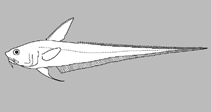
This species is distinguished by the following characters: without a large, scaly, tubercular swelling anterior to anus; pelvic-fin rays 15; absence of enlarged scutes at snout tip; presence of prominent open pores along cephalic sensory canals; mandibular rami is almost entirely naked except for posterior portions; with scaly patches on lower portions of branchiostegal rays; body scales covered with long, moderately reclined, needle-like spinules in convergent rows; D1 II,10-11; pectoral-fin rays i22-i27; inner gill rakers on first arch 9; upper jaw length 31-32% HL. Colour of first dorsal fin blackish and the oral cavity pale (Ref. 123356)
Cross section: compressed.
Cycle de vie et comportement reproducteur
Maturité | Reproduction | Frai | Œufs | Fécondité | Larves
Nakayama, N., 2020. Grenadiers (Teleostei: Gadiformes: Macrouridae) of Japan and adjacent waters, a taxonomic monograph. Megataxa 3(1):1-383. (Ref. 123356)
Statut dans la liste rouge de l'IUCN (Ref. 130435: Version 2025-2 (Global))
Menace pour l'homme
Harmless
Utilisations par l'homme
Outils
Articles particuliers
Télécharger en XML
Sources Internet
Estimations basées sur des modèles
Indice de diversité phylogénétique (Réf.
82804): PD
50 = 0.5078 [Uniqueness, from 0.5 = low to 2.0 = high].
Bayesian length-weight: a=0.00219 (0.00111 - 0.00432), b=3.20 (3.03 - 3.37), in cm total length, based on LWR estimates for this (Sub)family-body shape (Ref.
93245).
Niveau trophique (Réf.
69278): 3.4 ±0.5 se; based on size and trophs of closest relatives
Résilience (Réf.
120179): Milieu, temps minimum de doublement de population : 1,4 à 4,4 années (Preliminary K or Fecundity.).
Vulnérabilité de la pêche (Ref.
59153): Low vulnerability (12 of 100).
🛈