>
Gadiformes (Cods) >
Macrouridae (Grenadiers or rattails)
Etymology: Coelorinchus: Greek, koilos = a hollow + Greek, rhyngchos = jaw (Ref. 45335); lanceolatus: Name from Latin adjective 'lanceolatus' meaning 'armed with a lance', referring to the species’ long snout tipped with a spearhead-shaped scute.
Ambiente: milieu / zona climática / intervalo de profundidade / gama de distribuição
Ecologia
marinhas bentopelágico; intervalo de profundidade 521 - 536 m (Ref. 123356). Temperate
Northwest Pacific: Japan.
Tamanho / Peso / Idade
Maturidade: Lm ? range ? - ? cm
Max length : 26.0 cm TL macho/indeterminado; (Ref. 123356)
Descrição breve
Chaves de identificação | Morfologia | Morfometria
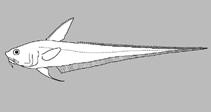
This species is distinguished by the following characters: external light organ a short, narrow, naked streak immediately anterior to anus, its anterior margin falling far short of line connecting inner pelvic-fin bases; underside of head almost completely naked; dorsal surface of snout is fully scaled, except the narrow naked clefts along each side of median rostral ridge; nasal fossa heavily scaled anteroventrally; snout very long, sharply pointed, its length 107% postrostral length (PRL); dorsal profile of snout moderately concave in lateral view; terminal snout scute long, slender, spearhead-shaped, dorsoventrally flattened, its length 27% PRL; scales on median rostral ridge covered with divergent rows of spinules; lateral nasal ridge is completely supported by nasal bone, almost straight when viewed dorsally, giving it a sharply pointed and distinctly attenuated appearance to snout; anus slightly separated from anal-fin origin; premaxillary teeth small, conical and arranged in a short, uniformly wide band, none especially enlarged; posterior margin of tooth band falling far short of the lateral corner of mouth; body scales are covered with short, reclined, keel-like spinules in narrowly divergent, saw-toothed ridges; every spinule row is complete, extending to posterior scale margin; spinules in each row greatly overlapping, closely adjoined to one another, but generally free at the tips; buttresses only narrowly developed; occipital scales covered with short, erect, keel-like spinules in widely divergent, saw-toothed rows; postorbital length 53% postrostral length (PRL); preoral length 101% PRL; prepelvic length 227% PRL; preanal length 292% PRL; predorsal length 214% PRL; height of first dorsal fin 84% PRL; interdorsal length 34% PRL; free neuromasts on the underside of head are tiny, immaculate, difficult to distinguish; no dark hair-like papillae on underside of head. Colouration: body uniformly pale in preserved specimen; lips white while oral cavity is blackish (Ref. 123356).
Ciclo de vida e comportamento de acasalamento
Maturidade | Reprodução | Desova | Ovos | Fecundidade | Larvas
Nakayama, N., 2020. Grenadiers (Teleostei: Gadiformes: Macrouridae) of Japan and adjacent waters, a taxonomic monograph. Megataxa 3(1):1-383. (Ref. 123356)
Categoria na Lista Vermelha da IUCN (Ref. 130435: Version 2025-2 (Global))
Ameaça para o homem
Harmless
Utilização humana
Pescarias: sem interesse
Ferramentas
Relatórios especiais
Descarregue XML
Fontes da internet
Estimativas baseadas em modelos
Índice de diversidade filogenética (Ref.
82804): PD
50 = 0.5000 [Uniqueness, from 0.5 = low to 2.0 = high].
Bayesian length-weight: a=0.00257 (0.00132 - 0.00501), b=3.19 (3.02 - 3.36), in cm total length, based on LWR estimates for this Genus-body shape (Ref.
93245).
Nível Trófico (Ref.
69278): 3.5 ±0.5 se; based on size and trophs of closest relatives
Resiliência (Ref.
120179): Médio, tempo mínimo de duplicação da população 1,4 - 4,4 anos (Preliminary K or Fecundity.).
Vulnerabilidade da pesca (Ref.
59153): Low vulnerability (16 of 100).
🛈