>
Perciformes/Uranoscopoidei (Sand dwellers) >
Pinguipedidae (Sandperches)
Etymology: Parapercis: Greek, para = the side of + Greek, perke = perch (Ref. 45335); nigrodorsalis: Name from the Latin 'nigro' for black and 'dorsalis' for dorsal fin, referring to the distinctive black
spinous dorsal-fin membrane of the species.
Ambiente: milieu / zona climática / intervalo de profundidade / gama de distribuição
Ecologia
marinhas demersal; intervalo de profundidade 56 - 280 m (Ref. 116625). Tropical
Southwest Pacific: New Zealand.
Tamanho / Peso / Idade
Maturidade: Lm ? range ? - ? cm
Max length : 15.6 cm SL macho/indeterminado; (Ref. 116625)
Descrição breve
Chaves de identificação | Morfologia | Morfometria
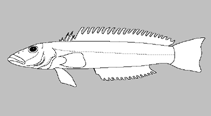
Espinhos dorsais (total) : 5; Raios dorsais moles (total) : 23; Espinhos anais: 1; Raios anais moles: 19; Vértebras: 32. This species is distinguished by the following set of characters: D V,23; A I,19; pectoral-fin rays 19-21 (modally 19); lateral-line scales 57-63 (modally 60); gill rakers 5-6 + 8-10 = 13-15 (modally 14); predorsal cycloid scales 9-11; scales ctenoid on cheek (except few anteriorly on preorbital), in about 18 horizontal rows; front of lower jaw wth 6 canine teeth in outer row; vomer with 2 rows of robust conical teeth in adults; palatines with 1-2 rows of small teeth; angle of subopercle smooth, no spinules; vertebrae, abdominal 10 and caudal 22; pelvic fins reaching between vent and the base of second anal-fin ray. Colouration: upper body between spinous dorsal fin and caudal peduncle with 7 broad reddish-brown vertical bands, each band except first and last partially bifurcated into two close-set double bars, and each bar with a black smudge-like spot at its lower end, the membrane of spinous dorsal-fin black (Ref. 116625).
Cross section: oval.
Occurs on rocky reef, gravel and rubble bottom on Wanganella Bank, western Norfolk Ridge, Tasman Sea, south to the North Island of New Zealand, from North Taranaki Bight, north to the Three Kings Islands and south-east to the Bay of Plenty and Colville Ridge, in depths of 56 to 280 m. Apparently relatively common where suitable habitat exists, with 14 specimens collected by trawl in depths of 56–280 m. The species has also been observed and photographed off the North Island of New Zealand by divers using rebreather apparatus in depths of 55-71 m in the Poor Knights Islands Marine Reserve, at locations known locally as Ngaroimata Point, Northern Arch, Serpent Rock and Landing Bay Pinnacle. A large individual was identified from an underwater photograph taken by Kendall Clements in 2010 at 'The Archways', Burgess Island, Mokohinau Group, outer Hauraki Gulf, at a depth of 16-20 m which is the shallowest confirmed record for the species (Ref. 116625).
Ciclo de vida e comportamento de acasalamento
Maturidade | Reprodução | Desova | Ovos | Fecundidade | Larvas
Johnson, J.W., C.D. Struthers and J. Worthington Wilmer, 2014. Parapercis nigrodorsalis (Perciformes: Pinguipedidae), a new species of san-perch from northern New Zealand and the Norfolk Ridge, Tasman Sea and remarks on P. binivirgata (Waite, 1904). Zootaxa 3856(4):484-500. (Ref. 116625)
Categoria na Lista Vermelha da IUCN (Ref. 130435: Version 2025-2 (Global))
Ameaça para o homem
Harmless
Utilização humana
Ferramentas
Relatórios especiais
Descarregue XML
Fontes da internet
Estimativas baseadas em modelos
Índice de diversidade filogenética (Ref.
82804): PD
50 = 0.5000 [Uniqueness, from 0.5 = low to 2.0 = high].
Bayesian length-weight: a=0.00692 (0.00314 - 0.01524), b=3.06 (2.88 - 3.24), in cm total length, based on LWR estimates for this Genus-body shape (Ref.
93245).
Nível Trófico (Ref.
69278): 3.5 ±0.4 se; based on size and trophs of closest relatives
Resiliência (Ref.
120179): Elevada, tempo mínimo de duplicação da população menor que 15 meses (Preliminary K or Fecundity.).
Vulnerabilidade da pesca (Ref.
59153): Low vulnerability (10 of 100).
🛈