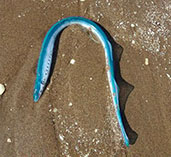
>
Petromyzontiformes (Lampreys) >
Geotriidae (Southern lampreys)
Etymology: Geotria: Etymology not explained, although three possibilities, all problematical, have been proposed: (1) from the Greek geotragia, “eating of earth-like substances,” referring to how this lamprey, like other lampreys, uses its suctorial mouth to attach itself to submerged rocks and stones, thus creating the impression that it is feeding on the earth (problem: geotragia does not mean “earthy,” as in rocks and minerals, but “products of the earth,” such as grains and vegetables; (2) geo- (Gr.), earth, and atrium (L.), room, referring to this lamprey’s nest, presumably made of stones and pebbles assembled by one or both parents (problem: nest-building, while known in other river lampreys, was probably not known to Gray in 1851 and has not been documented for this species); (3) a variation of #2, proposed by Meagher (2010), referring to its discovery in underground chambers, in which it survives dry periods (problem: G. australis does not, nor does any other lamprey, aestivate, nor did Gray indicate it was discovered underground, although he did speculate whether the pouch was an adaptation to the “long drought of the Australian rivers”). See EthyFish.org for more details (See ETYFish); macrostoma: macro-, from makros (Gr.), large; stoma (Gr.), mouth (but used here as an adjective, mouthed), presumably referring to greatly expanded oral disc of spawning adults (See ETYFish).
Taxonomic Remarks
Previously synonymized with Geotria australis Gray, 1851. See Ref. 125540 for explanations about the resurrection from Geotria australis.
Môi trường: môi trường / vùng khí hậu / Mức độ sâu / phạm vi phân phối
Sinh thái học
biển; nước ngọt; thuộc về nước lợ gần đáy; không rõ. Temperate
South America and Southwest Atlantic Islands: De la Plata River, Uruguay; de la Plata
River to Tierra del Fuego, Argentina; Malvinas (Falkland) Islands, South Georgia. One record in a river tributary of Magellan Strait in Chile.
Bộ gần gũi / Khối lượng (Trọng lượng) / Tuổi
Chín muồi sinh dục: Lm ? range ? - ? cm
Max length : 62.9 cm TL con đực/không giới tính; (Ref. 125560)
Mô tả ngắn gọn
Khóa để định loại | Hình thái học | Sinh trắc học
This species is distinguished from G. australis by having a second dorsal fin connected with the caudal fin by a low skin fold (vs. separate), and by the position of the cloaca posterior to the origin of the second dorsal fin in immature and mature adults (cloaca anterior to or under the origin of the second dorsal fin); while the position of fins and cloaca of mature G. macrostoma remains similar to that of juvenile and sub-adults, in spawning adults of G. australis the separation between the second dorsal fin and the caudal fin becomes reduced to a notch (Ref. 125560).
Cross section: oval.
Length of sub-adult individuals 41.2-62.9 cm TL (Ref. 125560).
Vòng đời và hành vi giao phối
Chín muồi sinh dục | Sự tái sinh sản | Đẻ trứng | Các trứng | Sự sinh sản | Ấu trùng
Firpo Lacoste, F., L. Fernández and C. Scioscia, 2021. On an unknown lamprey holotype (Petromyzon macrostomus Burmeister 1868) and the genus Exomegas Gill 1883 from South America. J. Fish Biol. 99(4):1507-1512. (Ref. 125540)
Tình trạng Sách đỏ IUCN (Ref. 130435: Version 2025-2 (Global))
Mối đe dọa đối với con người
Sử dụng của con người
Các công cụ
Báo cáo đặc biệt
Tải xuống XML
Các nguồn internet
Ước tính dựa trên mô hình
Chỉ số đa dạng phát sinh loài (Tài liệu tham khảo
82804): PD
50 = 1.0000 [Uniqueness, from 0.5 = low to 2.0 = high].
Bayesian length-weight: a=0.00102 (0.00046 - 0.00225), b=3.06 (2.88 - 3.24), in cm total length, based on all LWR estimates for this body shape (Ref.
93245).
Mức dinh dưỡng (Tài liệu tham khảo
69278): 4.4 ±0.8 se; based on size and trophs of closest relatives
Sự dễ bị tổn thương của nghề đánh cá (Ref.
59153): Moderate to high vulnerability (45 of 100).
🛈