>
Perciformes/Cottoidei (Sculpins) >
Liparidae (Snailfishes)
Etymology: Careproctus: Greek, kara = face + Greek, proktos = anus (Ref. 45335); brevipectoralis: Name from Latin words 'brevis' for short and 'pectus' for chest and pectoral, referring to the pectoral fins of this species that are short compared with other species.
Environnement : milieu / zone climatique / profondeur / gamme de distribution
Écologie
marin bathydémersal; profondeur 3300 - 3301 m (Ref. 123108). Deep-water
Kuril Basin of the Sea of Okhotsk
Taille / Poids / Âge
Maturité: Lm ? range ? - ? cm
Max length : 15.0 cm SL mâle / non sexé; (Ref. 123108)
Description synthétique
Clés d'identification | Morphologie | Morphométrie
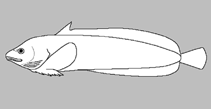
Rayons mous dorsaux (Total) : 49; Rayons mous anaux: 43; Vertèbres: 55. This species is distinguished by the following set of characters: vertebrae 55 (10+45), no pleural ribs; D 49, A 43, P 26, C 9 (principal rays); hypural is unslitted; head small, 17.7 % SL; preanal length 34.0 % SL; body is deep behind the head (119 % lc) and above anal-fin origin (113 % lc), end of tail thin (at about one fifth SL); eye 26.4 % lc; pelvic disk 41.5 % lc; pores 2-6-7-1; pectoral-fin upper lobe short (11.3 % SL), lower lobe slightly longer (13.3 % SL). Colouration: when fresh it is grayish brown with reddish tint; peritoneum black (Ref. 123325).
Cross section: oval.
The sediment from the Agassiz trawl included gray and brown silt and the bycatch was dominated by the holothurians Molpadia sp., Echiura and glass sponges; polychaetes were numerous (not less than 12 species including Travisia sp.). Also gorgonians and alcionarians, as well as ascidia of Culeolus sp., colonies of bryozoans Kinetoskias were few (Ref. 123108).
Cycle de vie et comportement reproducteur
Maturité | Reproduction | Frai | Œufs | Fécondité | Larves
Chernova, N., R. Thiel and I. Eidus, 2020. Four new species of Careproctus (Cottoidei: Liparidae) from the deep-water vicinity of the southern Kuril Islands (Western North Pacific). Zootaxa 4821(1):71-87. (Ref. 123108)
Statut dans la liste rouge de l'IUCN (Ref. 130435: Version 2025-2 (Global))
Menace pour l'homme
Harmless
Utilisations par l'homme
Pêcheries: sans intérêt
Outils
Articles particuliers
Télécharger en XML
Sources Internet
Estimations basées sur des modèles
Indice de diversité phylogénétique (Réf.
82804): PD
50 = 0.5000 [Uniqueness, from 0.5 = low to 2.0 = high].
Bayesian length-weight: a=0.00447 (0.00203 - 0.00984), b=3.17 (2.99 - 3.35), in cm total length, based on LWR estimates for this Genus-body shape (Ref.
93245).
Niveau trophique (Réf.
69278): 3.3 ±0.5 se; based on size and trophs of closest relatives
Résilience (Réf.
120179): Haut, temps minimum de doublement de population inférieur à 15 mois (Preliminary K or Fecundity.).
Vulnérabilité de la pêche (Ref.
59153): Low vulnerability (10 of 100).
🛈