分类 / 名称
俗名 | 同种异名 | Catalog of Fishes(属, 种) | ITIS | CoL | WoRMS | Cloffa
Teleostei >
Siluriformes (Catfishes) >
Mochokidae (Squeakers or upside-down catfishes) > Mochokinae
Etymology: Synodontis: Greek, syn, symphysis = grown together + Greek, odous = teeth (Ref. 45335); denticulatus: The specific epithet, denticulatus, from the Latin denticulatus, meaning denticulate or with small teeth, a reference to the well-marked and quite numerous denticles on the posterior margin of dorsal spine of this species (Ref. 122878).
环境:氛围 / 气候带 / 深度上下限 / 分布范围
生态学
; 淡水 底中水层性; pH range: 7.1 - 8.3. 23°C - 30°C (Ref. 122878)
Africa: Lufira River, Congo River basin, in Democratic Republic of the Congo (Ref. 122878).
大小 / 重量 / 年龄
成熟度: Lm ? range ? - ? cm
Max length : 8.9 cm SL 雄鱼/尚未辨别雌雄; (Ref. 122878)
简单描述
检索表 | 型态特徵 | 形态测量图
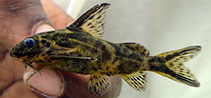
背棘 (总数) : 2; 背的软条 (总数) : 7 - 8; 臀棘: 3 - 4; 臀鳍软条: 7 - 9. Diagnosis: Synodontis denticulatus differs from its upper Lualaba and Bangweulu-Mweru congeners by the following unique combination of characters: anterior margin of pectoral spine serrated, vs. not serrated in S. pleurops; humeral process triangular and clearly pointed posteriorly, vs. not triangular and instead clearly truncated or rounded posteriorly in S. congicus, S. notatus and S. smiti; high number of mandibular teeth, 30-58 vs. lower, 0-10 in S. decorus, 18-25 in S. katangae, 23-27 in S. lufirae and 13-24 in S. polystigma; short adipose-fin length, 17.8-26.2% of standard length, vs. long, 32.3-37.1% in S. acanthomias, 30.2-36.2% in S. alberti, 32.7-42.9% in S. dorsomaculatus and 27.3-32.6% in S. nigromaculatus; and a non-villous skin on flanks vs. villous skin in S. greshoffi and S. unicolor, short maxillary barbels, 77.6-123.3% of head length vs. usually longer, 108-195% in S. greshoffi and 83.6-165.3% in S. unicolor, a low number of short serrations on anterior margin of pectoral spine, 8-14, vs. high number of long serrations, 9-23 in S. greshoffi and 11-20 in S. unicolor, and a high number of serrations on posterior margin of dorsal spine, 7-15, vs. a low number of serrations on posterior margin of dorsal spine, 2-15 in S. greshoffi and 5-11 in S. unicolor (Ref. 122878). Furthermore, Synodontis denticulatus differs from the remaining of its Congo Basin congeners, including those from Lake Tanganyika basin and associated river systems, by the following unique combination of characters: dorsal spine without strong serration on its anterior margin vs. with strong serrations in S. batesii and S. longispinis; dorsal spine with strong serration on its posterior margin vs. no serrations in S. nigriventris; humeral process triangular and clearly pointed posteriorly vs. triangular but instead with a clearly blunted point posteriorly in S. dhonti, not triangular and instead clearly truncated posteriorly in S. robertsi; high number of mandibular teeth, 30-58, vs. low, 14-18 in S. brichardi, 20 in S. camelopardalis, 20-27 in S. flavitaeniatus, 15-29 in S. irsacae, 19-30 in S. longirostris, 14-24 in S. multipunctatus, 12-19 in S. nummifer, 18-23 in S. pardalis, 17-28 in S. schoutedeni, 17-26 in S. grandiops, 13-19 in S. ornatissimus and 10 in S. vaillanti; short adipose-fin length, 17.8-26.2% of standard length, vs. long, 30.7-34.8% in S. caudalis, 28.2-31.4% in S. cuangoanus, 35.4-37.1% in S. depauwi, 29.4-33.7% in S. iturii, 31.6% in S. multimaculatus, 33.2-40.0% in S. petricola, 29.2-45.6% in S. polli, 29.7-34.1% in S. soloni, 28.2-33.3% in S. victoriae, 31.2-44.8% in S. ilebrevis, 27.6-38.7% in S. lucipinnis and 28.0-33.4% in S. macropunctatus; non-villous skin on the flanks vs. villous skin in S. afrofischeri; its unique body colouration characterised by dark brown or black, dark-grey, spots and marbling on a yellowish, light brown, background vs. body with brownish to black background with small, light brown spots and sometimes with vertical sinusoid bars as well in S. angelicus, body dark brown to blackish covered with lighter vermiculations in S. aterrimus, body with distinct, large, dark brown, black spots on a lighter coloured network in S. centralis, uniformly brownish body, or with small, black spots on upper and lower part of flanks in juveniles in S. granulosus, body greyish to cuprous brown in colour with numerous small black spots, sometimes confluent in S. melanostictus, uniform brownish body colouration with or without numerous, small, black spots in S. nigrita, body with six vertical dark brown bars in juveniles modified more or less into two series of, unequally sized, dark brown spots in S. ornatipinnis, body with a few, large, rounded, back spots only in S. pulcher, yellowish or beige to whitish coloured body covered with large, dark brown spots in juveniles, becoming uniformly greyish with size in S. rukwaensis, and body with a uniform greyish background colour with or without numerous small black spots in S. tanganyicae and S. zambezensis; and long maxillary barbels, 77.6-123.3% of head length, vs. shorter, 50.5-75.8% in S. contractus (Ref. 122878). Finally, Synodontis denticulatus differs from its congeners from southern Africa by the following unique combination of characters: a high number of mandibular teeth, 30-58, vs. low, 12-22 in S. leopardinus, 18-27 in S. macrostigma, 13-21 in S. macrostoma, 12-24 in S. nebulosus, 17-28 in S. thamalakanensis, and 14-24 in S. woosnami; a short adipose-fin length, 17.8-26.2% of standard length, vs. long, 27.3-32.6% in S. nigromaculatus; and its unique body colouration characterised by dark brown spots and marbling on a yellowish, light brown, background vs. dark brown to black, eye-sized, markings, usually spot or bars merging into a maze-like network, on a light brown to olive brown background in S. vanderwaali, and a uniform greyish background colour with or without numerous small black spots in S. zambezensis (Ref. 122878).
Body shape (shape guide): fusiform / normal.
生命周期和交配行为
成熟度 | 繁殖 | 产卵场 | 卵 | 孕卵数 | 仔鱼
Kasongo Ilunga, M.: Abwe, E., E. Decru, A. Chocha Manda and E. Vreven, 2020. Description of a new small-sized Synodontis species (Siluriformes: Mochokidae) that is important for local subsistence fisheries in the middle Lufira (upper Congo River, DR Congo). J. Fish Biol. 96(5):1142-1159. (Ref. 122878)
世界自然保护联盟红皮书 (Ref. 130435: Version 2025-2 (Global))
人类利用
工具
特别资料
下载 XML
网络资源
基于模型的估算
系统发育多样性指数 (参考文献
82804): PD
50 = 0.5000 [Uniqueness, from 0.5 = low to 2.0 = high].
Bayesian length-weight: a=0.01096 (0.00461 - 0.02608), b=3.00 (2.81 - 3.19), in cm total length, based on LWR estimates for this Genus-body shape (Ref.
93245).
营养阶层 (参考文献
69278): 2.9 ±0.4 se; based on size and trophs of closest relatives
回复力 (参考文献
120179): 高度, 族群倍增时间少于 15个月 (Preliminary K or Fecundity.).
渔业脆弱性 (Ref.
59153): Low vulnerability (10 of 100).
🛈