分類 / 名前
共通名の | 類義語 | Catalog of Fishes(部類, 種) | ITIS | CoL | WoRMS | Cloffa
>
Cichliformes (Cichlids, convict blennies) >
Cichlidae (Cichlids) > Pseudocrenilabrinae
Etymology: Labeotropheus: Latin, labeo = one who has large lips + Greek, tropaion = defeat, a memorial of a fighting war, trophy; because of their specialized teeth were such an obvious feeding adaptation (Ref. 45335); artatorostris: The specific epithet is a composite of two Latin words, artatus, meaning constricted or shortened, and rostris, meaning nose or snout; this refers to the short snout pad that is characteristic of this species, especially in comparison to the type specimens of Labeotropheus fuelleborni (Ref. 116021).
環境:環境 / 気候帯 / 深さの範囲 / 分布範囲
生態学
; 新鮮な水 底生の漂泳性. Tropical
Africa: Mumbo Island and Thumbi West Island, Lake Malawi, in Malawi (Ref. 116021).
サイズ / 重さ / 年齢
成熟: Lm ? range ? - ? cm
Max length : 11.5 cm SL オス/雌雄の選別がない; (Ref. 116021)
簡単な記述
検索表 | 形態学 | 形態計測学
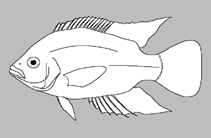
背面の脊椎 (合計) : 15 - 18; 背鰭 (合計) : 8 - 9; 肛門の骨: 3; 臀鰭: 6 - 8. Diagnosis: All diagnostic characteristics of Labeotropheus are present, including a steeply sloping head; broad, fleshy snout; wide jaws with retrognathous lower jaw; and an interior and subterminal mouth (Ref. 116021). Labeotropheus artatorostris differs from the slender-bodied Labeotropheus, L. trewavasae and L. simoneae, by its deeper body depth, 34.3-42.0% of standard length vs. 26.9-30.8% in L. simoneae and 25.3-33.4% in L. trewavasae; greater distance between insertion of dorsal fin and origin of anal fin, 29.2-34.0% of standard length vs. 27.4-28.6% in L. simoneae and 26.3-29.1% in L. trewavasae; and greater distance between origin of dorsal fin and insertion of pelvic fins, 36.1-41.1% of standard length vs. 27.5-32.8% in L. simoneae and 26.1-32.7% in L. trewavasae (Ref. 116021). Labeotropheus artatorostris is different from L. curvirostris by having more teeth rows in both the upper and lower jaws, 5-8 vs. 3 and 3-8 vs. 1, respectively; more infraorbital neuromasts, 12-36 vs. 9; shorter upper jaw, 15.6-22.9% of head length vs. 23.6%; and a narrower snout, 33.2-40.2% of head length vs. 42.6% (Ref. 116021). It differs from L. fuelleborni due to a shorter snout pad, 7.43-14.2% of head length vs. 14.9-17.2% in L. fuelleborni and 9.0-17.2% in types of L. fuelleborni and Messule specimens; more rows of teeth in the upper jaw, 5-8 vs. 4-5 in L. fuelleborni types and Messule specimens; and more gillrakers on the first ceratobranchial, 7-10 vs. 7-8 in L. fuelleborni (Ref. 116021). It differs from L. chlorosiglos due to greater distance between the opercular tabs, 16.6-18.7% of standard length vs. 14.7-15.7% in L. chlorosiglos; and greater distance between origin of dorsal fin and insertion of pelvic fin, 36.1-41.1% of standard length vs. 33.0-36.0% in L. chlorosiglos (Ref. 116021). Labeotropheus artatorostris also has longer pectoral fins, 24.6-33.3% of standard length, than all other species of Labeotropheus: 22.2-26.0% in L. chlorosiglos, 23.1-25.7% in L. fuelleborni, 22.2-29.3% in L. fuelleborni types and Messule specimens, 21.9-26.3% in L. simoneae, and 18.4-23.9% in L. trewavasae; it has also a wider body than all other species of Labeotropheus, body width at pectoral fins 14.0-18.3% of standard length vs. 12.7-14.3% in L. chlorosiglos, 15.0-16.9% in L. fuelleborni, 13.1-17.9% in L. fuelleborni types and Messule specimens, 13.0-15.6% in L. simoneae, and 12.1-16.6% in L. trewavasae; body width at opercular tabs 16.6-18.7% of standard length vs. 14.7-15.7% in L. chlorosiglos, 16.2-18.2% in L. fuelleborni, 15.3-18.4% in L. fuelleborni types and Messule specimens, 14.7-16.7% in L. simoneae, and 12.1-16.6% in L. trewavasae (Ref. 116021). Finally, L. artatorostris differs from all other species of Labeotropheus based on fin colouration of males: presence of orange-red pigmentation in pelvic, anal, and rayed dorsal fins in L. artatorostris vs. all fins blue in L. fuelleborni and L. trewavasae, and whitish-blue anal and yellow-rayed dorsal fins in L. chlorosiglos and L. simoneae; Labeotropheus artatorostris also lacks the large orange flank patch found in L. chlorosiglos and L. simoneae, and the orange pigmentation present on operculum of L. simoneae (Ref. 116021).
Body shape (shape guide): short and / or deep.
ライフサイクルと交尾行動
成熟 | 繁殖 | 放精 | 卵 | 生産力 | 幼生
Pauers, M.J., 2017. A new species of Labeotropheus (Perciformes: Cichlidae) from Southern Lake Malawi, Africa. Copeia 105(2):399-414. (Ref. 116021)
IUCNのレッドリストの状況は (Ref. 130435: Version 2025-2 (Global))
人間の用途
水産業: 興味がない
用具
特記事項
XMLをダウンロードして下さい
インターネットの情報源
モデルに基づく推定値
系統多様性指数 (参照
82804): PD
50 = 0.5005 [Uniqueness, from 0.5 = low to 2.0 = high].
Bayesian length-weight: a=0.00389 (0.00180 - 0.00842), b=3.12 (2.94 - 3.30), in cm total length, based on all LWR estimates for this body shape (Ref.
93245).
栄養段階 (参照
69278): 3.4 ±0.4 se; based on size and trophs of closest relatives
回復力 (参照
120179): 高い, 15か月以下の倍増期間の最小個体群 (Preliminary K or Fecundity.).
漁業の脆弱性 (Ref.
59153): Low vulnerability (10 of 100).
🛈