>
Perciformes/Serranoidei (Groupers) >
Serranidae (Sea basses: groupers and fairy basslets)
Etymology: Chelidoperca: Greek, chelidon, -onos = swift, as black as a swift + Greek, perke = perch (Ref. 45335); flavolineata: Name from Latin 'favus' for yellow and 'linea' meaning line, referring to the characteristic yellow longitudinal stripe of the species; noun in apposition.
Taxonomic Remarks
e-publication
Environnement : milieu / zone climatique / profondeur / gamme de distribution
Écologie
marin démersal; profondeur 115 - 210 m (Ref. 123213). Tropical
Eastern Indian Ocean: Indonesia and northern Australia (Timor Sea).
Taille / Poids / Âge
Maturité: Lm ? range ? - ? cm
Max length : 11.6 cm SL mâle / non sexé; (Ref. 123213)
Description synthétique
Clés d'identification | Morphologie | Morphométrie
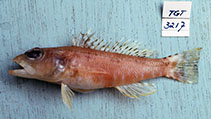
Épines dorsales (Total) : 10; Rayons mous dorsaux (Total) : 10; Épines anales: 3; Rayons mous anaux: 6 - 7. This species is distinguished from its congeners by the following set of characters (with modal values given in parentheses): pectoral-fin rays 15-16 (15); pored lateral-line scales 42-44 (43); scale rows in longitudinal series 42-46 (45) and between lateral line and base of 6th dorsal-fin spine 4 (3 full-sized size plus 1 half-sized); interorbital scales extending from the mid-orbit level to anterior margin of orbit; scales on ventral surface of the lower jaw extending anteriorly onto posterior portion of dentary. Colouration: head and body pinkish to reddish; with a longitudinal yellow stripe from snout (crossing eye) extending to caudal fn base; caudal fin upper lobe yellowish, lower lobe reddish, with several light bands on central portion and several small reddish (brownish when preserved) blotches on dorsal margin near base (Ref. 123213).
Cross section: compressed.
Collected by bottom trawl (Ref. 123213).
Cycle de vie et comportement reproducteur
Maturité | Reproduction | Frai | Œufs | Fécondité | Larves
Matsunuma, M., H.H. Tan and T. Peristiwady, 2020. Chelidoperca flavolineata, a new species of perchlet (Perciformes: Serranidae) from Indonesia and the first Indonesian record of C. maculicauda. Ichthyol. Res. 67(2):308-319. (Ref. 123213)
Statut dans la liste rouge de l'IUCN (Ref. 130435: Version 2025-2 (Global))
Menace pour l'homme
Harmless
Utilisations par l'homme
Pêcheries: bycatch
Outils
Articles particuliers
Télécharger en XML
Sources Internet
Estimations basées sur des modèles
Indice de diversité phylogénétique (Réf.
82804): PD
50 = 0.5000 [Uniqueness, from 0.5 = low to 2.0 = high].
Bayesian length-weight: a=0.01072 (0.00511 - 0.02246), b=3.06 (2.88 - 3.24), in cm total length, based on LWR estimates for this (Sub)family-body shape (Ref.
93245).
Niveau trophique (Réf.
69278): 3.6 ±0.5 se; based on size and trophs of closest relatives
Résilience (Réf.
120179): Milieu, temps minimum de doublement de population : 1,4 à 4,4 années (Preliminary K or Fecundity.).
Vulnérabilité de la pêche (Ref.
59153): Low vulnerability (10 of 100).
🛈