>
Acropomatiformes (Oceanic basses) >
Hemerocoetidae (Indo-Pacific duckbills)
Etymology: Pteropsaron: Greek, pteron = wing, fin + Greek, psaron = grey, with different colours (Ref. 45335); indicum: Named for its occurrence in the Indian waters; neuter singular adjective in nominative case.
Ambiente: milieu / zona climatica / distribuzione batimetrica / gamma di distribuzione
Ecologia
marino demersale; distribuzione batimetrica ? - 70 m (Ref. 123048). Tropical
Western Indian Ocean: India.
Dimensione / Peso / Età
Maturità: Lm ? range ? - ? cm
Max length : 8.4 cm SL maschio/sesso non determinato; (Ref. 123048)
Breve descrizione
Chiavi di identificazione | Morfologia | Morfometria
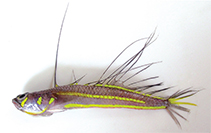
Spine dorsali (totale) : 3; Raggi dorsali molli (totale) : 27; Spine anali: 0; Raggi anali molli: 29; Vertebre: 38. This species of hemerocoetine trichonotid is distinguished by the following characters: dorsal fins 2 and well separated, D III, 27 with the spines rooted closely together, first dorsal fin with the first spine greatly elongated, second and third moderately extended, a fused pterygiophore complex placed between 4th and 5th neural spine and 5th spine bent down below complex, the second dorsal fin with 27 unbranched segmented rays, mid-fin rays greatly elongated; A 29, all but first two rays branched, none elongated; short pectoral fin, 17-18 rays, branched except one to three uppermost and one or two lowermost; P I,5, all rays branched and not elongated; extended filamentous uppermost branched caudal-fin ray; presence of a prominent maxillary spine; absence of barbels on head; dorsal operculum present on iris; head mostly scaled except cheek; lateral-line scales about 40, each large and with scalloped posterior margin; gill rakers 2 + 13; precaudal 10, caudal 28, total 38 vertebrae (including urostyle). Colouration: prominent bright-yellow midlateral stripe from pectoral-fin insertion to posterior body; a dorsal stripe along base of soft dorsal-fin rays extending out along upper portion of caudal fin; a ventral lateral stripe from mid-abdomen to base of caudal fin just above level of anal-fin base; three bright-yellow oblique bars anteriorly, one under the eye, second on opercle, and third over pectoral-fin base; branchiostegal rays bright yellow (Ref. 123048).
Cross section: circular.
Ciclo vitale e comportamento di accoppiamento
Maturità | Riproduzione | Deposizione | Uova | Fecondità | Larve
Victor, B. and A.B. Kumar, 2019. Pteropsaron indicum, a new species of signalfish (Teleostei: Trichonotidae: Hemerocoetinae) with a micro-CT analysis of osteology. J. Ocean Sci. Found. 33:70-78. (Ref. 123048)
Stato della Lista Rossa IUCN (Ref. 130435: Version 2025-2 (Global))
Minaccia per l'uomo
Harmless
Usi umani
Pesca: di nessun interesse
Strumenti
Rapporti speciali
Scarica XML
Fonti Internet
Stime basate su modelli
Indice di diversità filogenetica (Fonte Biblio.
82804): PD
50 = 0.5010 [Uniqueness, from 0.5 = low to 2.0 = high].
Bayesian length-weight: a=0.00389 (0.00180 - 0.00842), b=3.12 (2.94 - 3.30), in cm total length, based on all LWR estimates for this body shape (Ref.
93245).
Livello trofico (Fonte Biblio.
69278): 3.3 ±0.4 se; based on size and trophs of closest relatives
Resilienza (Fonte Biblio.
120179): Alto, tempo minimo di raddoppiamento della popolazione meno di 15 mesi (Preliminary K or Fecundity.).
Vulnerabilità della pesca (Ref.
59153): Low vulnerability (10 of 100).
🛈