>
Gobiiformes (Gobies) >
Gobiidae (Gobies) > Gobiinae
Etymology: Cryptocentrus: Greek, kryptos = hidden + Greek, kentron = sting (Ref. 45335); altipinna: Name from Latin 'altus' for high and 'pinna' meaning fin, referring to the very high first dorsal fin; noun in apposition.
Ambiente: milieu / zona climatica / distribuzione batimetrica / gamma di distribuzione
Ecologia
marino associati a barriera corallina. Tropical
Indian Ocean: from Tanzania, Sri Lanka, and the Andaman Sea off Thailand.
Dimensione / Peso / Età
Maturità: Lm ? range ? - ? cm
Max length : 5.5 cm SL maschio/sesso non determinato; (Ref. 119508); 5.9 cm SL (female)
Breve descrizione
Chiavi di identificazione | Morfologia | Morfometria
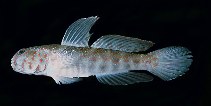
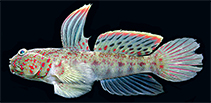
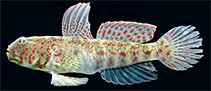
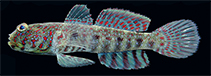
Spine dorsali (totale) : 7; Raggi dorsali molli (totale) : 10; Spine anali: 1; Raggi anali molli: 9. This species is distinguished by all features pertaining to the C. strigilliceps complex to which this species belongs to, including the following: first dorsal fin very high, much higher than second dorsal fin and about 1.2-1.5 times higher than body depth at anal-fin origin in adults and equal to depth at anal-fin origin in juveniles, with pointed margin, second to fourth spines distinctly longer than other spines, fourth spine longest in adult (second or third longest in juveniles), but not distinctly prolonged into a filament; mouth moderate, ending below posterior lower quarter of eye, just behind pupi, with jaws forming angle of 24-26° with body axis, upper margin of upper jaw in line with point about one-quarter to one-third pupil diameter below eye; gill opening reaching to below a point just under and before posterior preopercular margin; head papillae minute and not on distinct ridges; scales ctenoid posteriorly on body, becoming cycloid anteriorly on midside below posterior end of first dorsal fin; predorsal area naked, with scales reaching forward to a curved line from first dorsal-fin origin to upper pectoral-fin insertion; sides of head with irregularly shaped elongate spots and numerous small bluish white spots (black when preserved); sides of body with scattered, minute, bluish white spots and with irregularly shaped spots on midside with faint bands extending ventrally from spots; pelvic fins fused, with a frenum, and large, reaching to or just short of anus; longitudinal scale count 18-22 cycloid scale rows anteriorly plus 39-43 ctenoid scale rows posteriorly, total 59-65; transverse scale count (TRB)=20-22 (Ref. 119508).
Cross section: oval.
The species has been reported to occur from seagrass beds with sandy-mud bottoms (Ref. 119508).
Ciclo vitale e comportamento di accoppiamento
Maturità | Riproduzione | Deposizione | Uova | Fecondità | Larve
Hoese, D.F., 2019. A review of the Cryptocentrus strigilliceps complex (Teleostei: Gobiidae), with description of a new species. J. Ocean Sci. Found. 32:23-38. (Ref. 119508)
Stato della Lista Rossa IUCN (Ref. 130435: Version 2025-2 (Global))
Minaccia per l'uomo
Harmless
Usi umani
Strumenti
Rapporti speciali
Scarica XML
Fonti Internet
Stime basate su modelli
Indice di diversità filogenetica (Fonte Biblio.
82804): PD
50 = 0.5000 [Uniqueness, from 0.5 = low to 2.0 = high].
Bayesian length-weight: a=0.00741 (0.00347 - 0.01582), b=3.09 (2.91 - 3.27), in cm total length, based on LWR estimates for this (Sub)family-body shape (Ref.
93245).
Livello trofico (Fonte Biblio.
69278): 3.3 ±0.3 se; based on size and trophs of closest relatives
Resilienza (Fonte Biblio.
120179): Alto, tempo minimo di raddoppiamento della popolazione meno di 15 mesi (Preliminary K or Fecundity.).
Vulnerabilità della pesca (Ref.
59153): Low vulnerability (10 of 100).
🛈