Classificatie / Namen
Lokale namen | Synoniemen | Catalog of Fishes(Genus, Soort(en)) | ITIS | CoL | WoRMS | Cloffa
>
Perciformes/Scorpaenoidei (Scorpionfishes) >
Scorpaenidae (Scorpionfishes or rockfishes) > Scorpaeninae
Etymology: Scorpaena: Latin, scorpaena = a kind of fish, 1706 (Ref. 45335); wellingtoni: Named for Gerard M. Wellington, a pioneer in research on the marine biology and conservation in the Galápagos Archipelago.
Eponymy: Gerard M Wellington (d: 2014) was Professor of Biology at the University of Houston. [...] (Ref. 128868), visit book page.
Milieu: milieu / Klimaatzone / Diepte / verspreidingsgebied
Ecologie
marien rifbewoner. Tropical
Southeast Pacific: Galápagos Islands.
Grootte / Gewicht / Leeftijd
Maturiteit: Lm ? range ? - ? cm
Max length : 6.0 cm SL mannelijk / geslacht onbekend; (Ref. 94246)
Korte beschrijving
Determinatiesleutels | Morfologie | Morfometrie
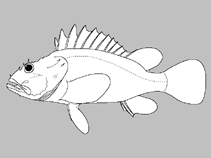
Dorsale stekels (totaal) : 12; Anale stekels: 3; Wervels: 24. This species is distinguished by the following characters: D XII,8½ (38 split to base); A III,5½; pectoral-fin rays 21, the second through fifth ray branched; penultimate dorsal-fin spine more than half length of ultimate spine; gill rakeres, upper-limb 4, lower 6-7; relatively deep body, depth 36.2-37.0 SL, upper body below spinous dorsal fin arched; eye large, snout short; occipital pit moderate to shallow, no significant suborbital pit; interorbital space narrow and shallow, its width 3.2-5.2% SL, width between supraocular spines 4.3-6.3% SL, interorbital ridges are not developed; suborbital ridge with 2 small spines, one at midpoint, one at end; simple lacrimal spines 2, posterior spine oriented straight down; preopercular spines 5, the first spine reaching halfway across operculum with no supplemental preopercular spine, second spine much shorter than third; upper posttemporal spine directed obliquely upward; with cleithral spine; lower rim of upper corneal layer (= “corneal drape”) of eye with rounded tabs associated with tentacles; lateral line scales 23, some with tentacles; anterior mandibular pores paired. Colouration: a dark bar on cheek below rear half of eye, dark blotches on operculum above and below the first preopercular spine, indistinct dark blotch on anterior mid-body, a series of dark spots and saddles along base of spinous and soft dorsal fins, dusky caudal peduncle, two dark bands on both the soft dorsal and anal fins, clear caudal fin, dark base and tip of pectoral fin, and dark pelvic fins (Ref. 94246).
Cross section: compressed.
Levenscyclus en paargedrag
Maturiteit | Voortplanting | Paaien | Eieren | Fecunditeit | Larven
Victor, B.C., 2013. Scorpaena wellingtoni n. sp., a new scorpionfish from the Galápagos Islands (Scorpaeniformes: Scorpaenidae). J. Ocean Sci. Found. 8:30-43. (Ref. 94246)
Status op de Rode Lijst van het IUCN (Ref. 130435: Version 2025-2 (Global))
Gevaar voor de mens
Harmless
Gebruik door de mens
Tools
Speciale rapporten
Download XML
Internetbronnen
Schattingen op basis van modellen
Fylogenetische diversiteitsindex (Ref.
82804): PD
50 = 0.5000 [Uniqueness, from 0.5 = low to 2.0 = high].
Bayesian length-weight: a=0.01349 (0.00638 - 0.02853), b=3.01 (2.84 - 3.18), in cm total length, based on LWR estimates for this Genus-body shape (Ref.
93245).
Trofisch niveau (Ref.
69278): 3.4 ±0.2 se; based on size and trophs of closest relatives
Weerstandsvermogen (Ref.
120179): Hoog, minimale populatieverdubbelingstijd minder dan 15 maanden (Preliminary K or Fecundity.).
Kwetsbaarheid van de visserij (Ref.
59153): Low vulnerability (10 of 100).
🛈