Classification / Noms
Noms communs | Synonymes | Catalog of Fishes(Genre, Espèce) | ITIS | CoL | WoRMS | Cloffa
>
Cyprinodontiformes (Rivulines, killifishes and live bearers) >
Rivulidae (Rivulines) > Rivulinae
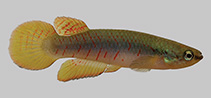
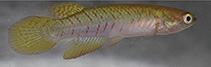
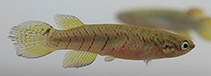
Etymology: interruptus: Name from Latin adjective meaning interrupted, referring to the presence of conspicuous oblique red bars forming chevron-like marks usually disrupted in the midline of the body in males.
Environnement : milieu / zone climatique / profondeur / gamme de distribution
Écologie
; eau douce benthopélagique. Tropical
South America: Brazil.
Taille / Poids / Âge
Maturité: Lm ? range ? - ? cm
Max length : 3.2 cm SL mâle / non sexé; (Ref. 119399); 2.9 cm SL (female)
Description synthétique
Clés d'identification | Morphologie | Morphométrie
This species is distinguished from all its congeners of the M. pictus group, except M. nigromarginatus, by having an oblique chevron-like bars interrupted, mainly on the midline of the flank in males (vs. bars continuous, vestigial, irregular or presence of longitudinal rows of red dots on the side of the body; never bars interrupted on the midline of the body); differs from all other species in the M. pictus species group, except M. planaltinus, M. leali, M. pictus, by having a rounded dorsal fin (vs. slight pointed or pointed dorsal fin); differs from M. amambaiensis, M. apiamici, M. egens, M. faucireticulatus, M. ivinhemensis, M. lealiby a higher caudal-fin ray count 32-33 (vs. 28-31); differs from M. egens, M. faucireticulatus, M. leali, M. litteratus, M. rutilicaudus, M. formosensis by the position of the anal-fin origin between the pleural ribs of 15th and 16th vertebrae (vs. 13th and 15th vertebrae); differs from M. apiamici, M. egens, M. faucireticulatus, M. pictus, M. polychromus, M. proximus by the dorsal-fin origin at a vertical through the base of the 8th anal-fin ray (vs. vertical through base of 7th or 9th-10th anal-fin ray); differs from M. amambaiensis, M. egens, M. faucireticulatus, M. ivinhemensis, M. planaltinus, M. polychromus, M. nigropunctatus, M. ofaie, M. formosensis by the origin of dorsal-fin between neural spines of 18th and 19th vertebrae (vs. 19th and 22th); differs from M. egens, M. faucireticulatus, M. leali, M. litteratus, M. scalaris, M. vittatus, M. linearis, M. proximus by the tip of pelvic fin reaching the urogenital papilla in males (vs. reaching 1st to 4th anal fin ray). Also, another interesting diagnostic character is the presence of 8 rays in the pelvic fin in about 35% of the analysed specimens (vs. 5-7 rays, never 8 rays present in the pelvic fin) (Ref. 119399).
Cross section: angular.
Recorded in a typical Cerrado area, inserted into the urban area of Campo Grande town at an altitude of 594 m a.s.l.. It was found in a small first order creek, but was only captured in border areas with dense aquatic vegetation, mainly grasses. The biotope, which is locally called 'veredas', a freshwater ecosystem comprising streams bordered by the buriti-palm, typically found in the Cerrado Biome, has moderate current speed. However, the area where the species was recorded is formed by small backwaters, with a clayey substrate and with a maximum depth of 10 cm. This species is encountered in areas exposed to the sun as well as in areas shaded by trees, mainly buritis-palm (Mauritia flexuosa). The region also has a slightly undulating terrain and according to the classification of Koppen-Geiger has rainy summers and dry winters (Ref. 119399).
Cycle de vie et comportement reproducteur
Maturité | Reproduction | Frai | Œufs | Fécondité | Larves
Volcan, M.V., F. Severo-Neto and L.E.K. Lanés, 2018. Unrecognized biodiversity in a world’s hotspot: three new species of Melanorivulus (Cyprinodontiformes: Rivulidae) from tributaries of the right bank of the Rio Paraná basin, Brazilian Cerrado. Zoosyst. Evol. 94(2):263-280. (Ref. 119399)
Statut dans la liste rouge de l'IUCN (Ref. 130435: Version 2025-2 (Global))
Menace pour l'homme
Harmless
Utilisations par l'homme
Outils
Articles particuliers
Télécharger en XML
Sources Internet
Estimations basées sur des modèles
Indice de diversité phylogénétique (Réf.
82804): PD
50 = 0.5000 [Uniqueness, from 0.5 = low to 2.0 = high].
Bayesian length-weight: a=0.00661 (0.00315 - 0.01385), b=3.10 (2.92 - 3.28), in cm total length, based on LWR estimates for this (Sub)family-body shape (Ref.
93245).
Niveau trophique (Réf.
69278): 3.1 ±0.4 se; based on size and trophs of closest relatives
Résilience (Réf.
120179): Haut, temps minimum de doublement de population inférieur à 15 mois (Preliminary K or Fecundity.).
Vulnérabilité de la pêche (Ref.
59153): Low vulnerability (10 of 100).
🛈