分類 / 名前
共通名の | 類義語 | Catalog of Fishes(部類, 種) | ITIS | CoL | WoRMS | Cloffa
板鰓亜鋼(サメとエイ類) (sharks and rays) >
Carcharhiniformes (Ground sharks) >
Carcharhinidae (Requiem sharks)
Etymology: Carcharhinus: karcharos (Gr.), sharp or jagged; rhinus, an ancient name for sharks, from rhine (Gr.), rasp, both words alluding to a shark's jagged, rasp-like skin (See ETYFish); obsoletus: Latin for extinct, referring to fact that it has not been recorded since 1934 [originally spelled obsolerus, a misspelling based on incorrect optical character recognition results at several online English-Latin translation sites] (See ETYFish).
環境:環境 / 気候帯 / 深さの範囲 / 分布範囲
生態学
海 底生の. Tropical
Western Pacific: collection records Gulf of Thailand, Vietnam and Malaysia (Borneo). Distribution is actually uncertain, with Baram in Sarawak (Malaysia) likely an accurate collection locality.
サイズ / 重さ / 年齢
成熟: Lm ? range ? - ? cm
Max length : 43.3 cm TL (female)
簡単な記述
検索表 | 形態学 | 形態計測学
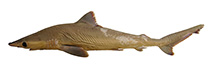
脊つい: 117 - 120. This small species is characterized by the following characters: a slender body and tail; no interdorsal ridge; in dorsal view head parabolic and is relatively wide, interorbital space 11.2-12.0% TL; eyes relatively large, its length 2.4-2.9% TL, 10.0-15.1 times in head length; row of enlarged hyomandibular pores alongside each mouth corner absent; upper anterior teeth broadly triangular and serrated, with large and coarse (non-lobate) serrations basally; lower anterior teeth with narrower, mostly straight cusps; the cusps of upper and lower anterolateral teeth with apical margin slightly recurved; lateral cusplets absent; total tooth row counts 27-31/26-29; posterior edge of mandibular plate with an elongate and crescentic indentation; second dorsal-fin origin well posterior of anal-fin origin, about opposite anal-fin midbase, while second dorsal-fin origin to anal-fin origin 1.3-2.5% TL, 0.3-0.6 times second dorsal-fin base; first dorsal-fin triangular, non-falcate, origin about opposite first third of pectoral-fin inner margin length, free rear tip just anterior to pelvic-fin origins, length 1.7-1.9 times height, inner margin 1.9-2.5 in base; second dorsal fin is much smaller than first, slightly smaller than anal fin, base 1.4-2.0 times height, height 22-31% of first dorsal-fin height; anal fin height 1.2-1.5 times second dorsal height, base 1.1-1.2 times second dorsal-fin base; total vertebral counts 117-120, monospondylous precaudal 36-40, diplospondylous precaudal 18-19, diplospondylous caudal 56-66, precaudal 54-58; absence of distinct black markings on fins (Ref. 119369).
Cross section: angular.
Maximum length (43.3 cm TL) is that of a juvenile female; size at birth likely close to 34.0 cm TL, since late-term embryo was fully developed and a 37.0 cm TL juvenile had a faint umbilical sca (Ref. 119369).
ライフサイクルと交尾行動
成熟 | 繁殖 | 放精 | 卵 | 生産力 | 幼生
White, W.T., P.M. Kyne and M. Harris, 2019. Lost before found: A new species of whaler shark Carcharhinus obsolerus from the Western Central Pacific known only from historic records. PLoS ONE 14(1):e0209387. (Ref. 119369)
IUCNのレッドリストの状況は (Ref. 130435: Version 2025-2 (Global))
人間の用途
用具
特記事項
XMLをダウンロードして下さい
インターネットの情報源
モデルに基づく推定値
系統多様性指数 (参照
82804): PD
50 = 0.5000 [Uniqueness, from 0.5 = low to 2.0 = high].
Bayesian length-weight: a=0.00389 (0.00180 - 0.00842), b=3.12 (2.94 - 3.30), in cm total length, based on all LWR estimates for this body shape (Ref.
93245).
栄養段階 (参照
69278): 3.8 ±0.5 se; based on size and trophs of closest relatives
回復力 (参照
120179): 低い, 4.5年~14年の倍増期間の最小個体群 (Few large pups (RF)).
漁業の脆弱性 (Ref.
59153): Low to moderate vulnerability (33 of 100).
🛈