Classificação / Nomes
Nomes comuns | Sinónimos | Catalog of Fishes(Género, Espécies) | ITIS | CoL | WoRMS | Cloffa
>
Characiformes (Characins) >
Acestrorhamphidae (American tetras) > Acestrorhamphinae
Etymology: Astyanax: The name of Astyanax, Hector´s son in the Greek mythology (Ref. 45335); boliviensis: Named for the country where the type series was collected, Bolivia.
Eponymy: Astyanax was the son of Hector in Greek mythology. See Homer’s Iliad for details. The reasoning for its use for a genus of characins is not explained. (Ref. 128868), visit book page.
Ambiente: milieu / zona climática / intervalo de profundidade / gama de distribuição
Ecologia
; Água doce bentopelágico. Tropical
South America: Upper Amazon River Basin of Bolivia and Peru.
Tamanho / Peso / Idade
Maturidade: Lm ? range ? - ? cm
Max length : 9.0 cm SL macho/indeterminado; (Ref. 119406)
Descrição breve
Chaves de identificação | Morfologia | Morfometria
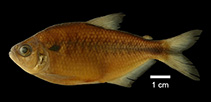
Raios dorsais moles (total) : 9. This species which is a member of the orthodus species-group of Astyanax differs from other species of the group in having lines extending from the tips of the chevrons on both the anterior and posterior extremes (proximal and distal sections of chevron extensions), forming etensions between the chevrons (vs. chevrons without lines extending from their tips), except A. moorii which is distinguished by the number of lateral-line scales 39-42 (vs. 44–50); also differs from A. moorii in the upper jaw length > 34% HL (vs. < 47% HL); further differs from A. villwocki by the absence of a dark stripe on the sides of the body (vs. with dark lateral stripe or anterior prolongation of the caudal peduncle spot extending over the silvery lateral stripe); differs from orthodus, embera, yariguies in having a distinct rhomboidal caudal-peduncle spot with a short, anterior, prolongation that does not surpass a vertical through the anal-fin origin (vs. spot on caudal peduncle a short polygon shape not surpassing the posterior tip of the anal fin in orthodus, embera and spot on caudal peduncle elongated as a stripe, continuing anteriorly to humeral region in A. villwocki; differs from A. bopiensis in having , 4 teeth extending over less than one third of the maxillary (vs. > 5 teeth extending over more than two thirds of the maxillary) (Ref. 119406).
Cross section: compressed.
Ciclo de vida e comportamento de acasalamento
Maturidade | Reprodução | Desova | Ovos | Fecundidade | Larvas
Ruiz-C., R.I., C. Román-Valencia, D.C. Taphorn, P.A. Buckup and H. Ortega, 2018. Revision of the Astyanax orthodus species-group (Teleostei: Characidae) with descriptions of three new species. European Journal of Taxonomy 402:1-45. (Ref. 119406)
Categoria na Lista Vermelha da IUCN (Ref. 130435: Version 2025-2 (Global))
Ameaça para o homem
Harmless
Utilização humana
Ferramentas
Relatórios especiais
Descarregue XML
Fontes da internet
Estimativas baseadas em modelos
Índice de diversidade filogenética (Ref.
82804): PD
50 = 0.5000 [Uniqueness, from 0.5 = low to 2.0 = high].
Bayesian length-weight: a=0.01905 (0.00849 - 0.04274), b=3.01 (2.83 - 3.19), in cm total length, based on LWR estimates for this Genus-body shape (Ref.
93245).
Nível Trófico (Ref.
69278): 2.9 ±0.4 se; based on size and trophs of closest relatives
Resiliência (Ref.
120179): Elevada, tempo mínimo de duplicação da população menor que 15 meses (Preliminary K or Fecundity.).
Vulnerabilidade da pesca (Ref.
59153): Low vulnerability (10 of 100).
🛈