Classification / Noms
Noms communs | Synonymes | Catalog of Fishes(Genre, Espèce) | ITIS | CoL | WoRMS | Cloffa
>
Characiformes (Characins) >
Acestrorhamphidae (American tetras) > Acestrorhamphinae
Etymology: Astyanax: The name of Astyanax, Hector´s son in the Greek mythology (Ref. 45335); embera: Named for the native Americans known as the Embera, who occupy the type locality of this new species; noun in apposition.
Eponymy: Astyanax was the son of Hector in Greek mythology. See Homer’s Iliad for details. The reasoning for its use for a genus of characins is not explained. (Ref. 128868), visit book page.
Environnement : milieu / zone climatique / profondeur / gamme de distribution
Écologie
; eau douce benthopélagique. Tropical
South America, Colombia.
Taille / Poids / Âge
Maturité: Lm ? range ? - ? cm
Max length : 8.3 cm SL mâle / non sexé; (Ref. 119406); 9.0 cm SL (female)
Description synthétique
Clés d'identification | Morphologie | Morphométrie
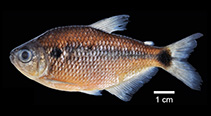
This species, a member of the orthodus species-group of Astyanax, differs from other members of the group by the following characters: differs from villwocki, superbus, gandhiae, bopiensi, boliviensis, yariguies by the absence of a dark stripe on the sides of the body (vs. dark lateral stripe present or anterior prolongation of the caudal peduncle spot extending anteriorly over the silvery lateral stripe); differs from A. orthodus in having the caudal peduncle spot extending onto the ventral and dorsal margins of the caudal peduncle, covering 4-6 horizontal scale rows (vs. covering 2-4 horizontal scale rows on the caudal peduncle) and in having an unpigmented band across the anal-fin rays in both sexes (vs.pigmentation uniform on analfin rays); differs from A. moorii in body depth > 39% SL (vs. < 39% SL), the dorsal-pectoral fin distance > 40.5% SL (vs. < 40.5% SL), maxilla length < 33.5% HL (vs. > 33.5% SH), upper jaw length < 32% HL (vs. > 47% SH) and by the number of lateral-line scales 36-41 (vs. 44-50) (Ref. 119406).
Cross section: compressed.
Cycle de vie et comportement reproducteur
Maturité | Reproduction | Frai | Œufs | Fécondité | Larves
Ruiz-C., R.I., C. Román-Valencia, D.C. Taphorn, P.A. Buckup and H. Ortega, 2018. Revision of the Astyanax orthodus species-group (Teleostei: Characidae) with descriptions of three new species. European Journal of Taxonomy 402:1-45. (Ref. 119406)
Statut dans la liste rouge de l'IUCN (Ref. 130435: Version 2025-2 (Global))
Menace pour l'homme
Harmless
Utilisations par l'homme
Outils
Articles particuliers
Télécharger en XML
Sources Internet
Estimations basées sur des modèles
Indice de diversité phylogénétique (Réf.
82804): PD
50 = 0.5000 [Uniqueness, from 0.5 = low to 2.0 = high].
Bayesian length-weight: a=0.01905 (0.00849 - 0.04274), b=3.01 (2.83 - 3.19), in cm total length, based on LWR estimates for this Genus-body shape (Ref.
93245).
Niveau trophique (Réf.
69278): 2.9 ±0.4 se; based on size and trophs of closest relatives
Résilience (Réf.
120179): Haut, temps minimum de doublement de population inférieur à 15 mois (Preliminary K or Fecundity.).
Vulnérabilité de la pêche (Ref.
59153): Low vulnerability (10 of 100).
🛈