>
Anguilliformes (Eels and morays) >
Muraenidae (Moray eels) > Muraeninae
Etymology: Gymnothorax: Greek, gymnos = naked + Greek, thorax, -akos = breast (Ref. 45335); smithi: Named for David G. Smith, United States National Museum.
[Entered by: 14 and Modified by: YOUR # Shift+Enter to Save the record before entering the Ref # in MainRef field.].
Eponymy: Dr David G Smith is an American ichthyologist who is a Museum Specialist at the Smithsonian Institution. [...] (Ref. 128868), visit book page.
Environnement : milieu / zone climatique / profondeur / gamme de distribution
Écologie
marin benthopélagique; profondeur ? - 200 m (Ref. 121832). Tropical
Western Indian Ocean, southeastern Arabian Sea, India.
Taille / Poids / Âge
Maturité: Lm ? range ? - ? cm
Max length : 61.5 cm TL mâle / non sexé; (Ref. 121832)
Description synthétique
Clés d'identification | Morphologie | Morphométrie
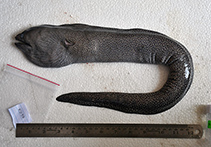
This species is distinguished by the following characters: a moderate sized moray eel with greyish brown colour overlain with small irregular white spots; anus is slightly behind mid-point of the body; broad head with short jaws, the snout tip blunt and short; eyes small and closer to rictus than to the snout tip; teeth pointed and serrated teeth, the vomerine teeth uniserial anteriorly, biserial centrally and uniserial posteriorly; branchial pores 1-2; vertebral count 3-5 /57/130-132 (Ref. 121832).
Known only from three type specimens collected by demersal trawl at about 200 m depth (on the basis of holotype, not known for paratypes) (Ref. 121832).
Cycle de vie et comportement reproducteur
Maturité | Reproduction | Frai | Œufs | Fécondité | Larves
Sumod, K.S., A. Mohapatra, V.N. Sanjeevan, T.G. Kishor and K.K. Bineesh, 2019. A new species of white-spotted moray eel, Gymnothorax smithi (Muraenidae: Muraeninae) from deep waters of Arabian Sea, India. Zootaxa 4652(2):359-366. (Ref. 121832)
Statut dans la liste rouge de l'IUCN (Ref. 130435: Version 2025-2 (Global))
Menace pour l'homme
Harmless
Utilisations par l'homme
Pêcheries: intérêt commercial mineur
Outils
Articles particuliers
Télécharger en XML
Sources Internet
Estimations basées sur des modèles
Indice de diversité phylogénétique (Réf.
82804): PD
50 = 0.5000 [Uniqueness, from 0.5 = low to 2.0 = high].
Bayesian length-weight: a=0.00047 (0.00025 - 0.00088), b=3.28 (3.13 - 3.43), in cm total length, based on LWR estimates for this Genus-body shape (Ref.
93245).
Niveau trophique (Réf.
69278): 4.0 ±0.6 se; based on size and trophs of closest relatives
Résilience (Réf.
120179): Milieu, temps minimum de doublement de population : 1,4 à 4,4 années (Preliminary K or Fecundity.).
Vulnérabilité de la pêche (Ref.
59153): Moderate vulnerability (45 of 100).
🛈