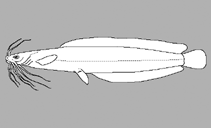
Classificação / Nomes
Nomes comuns | Sinônimos | Catalog of Fishes(Gênero, Espécies) | ITIS | CoL | WoRMS | Cloffa
>
Siluriformes (Catfishes) >
Clariidae (Airbreathing catfishes)
Etymology: Pseudotanganikallabes: From the Greek pseudo (ψευδής), meaning lying or false and the genus Tanganikallabes, in reference to the superficial resemblance between these two genera; prognatha: The specific epithet is derived from the prefix pro, in this case meaning anterior to and the Greek gnathos (γνάθος), meaning jaw, in reference to the distinctive protrusion of the lower jaw of this species; gender: feminine (Ref. 116742).
Meio ambiente: milieu / Zona climática / intervalo de profundidade / faixa de distribuição
Ecologia
; Água doce demersal. Tropical
Africa: southeastern coast of Lake Tanganyika in Zambia (Ref. 116742).
Tamanho / Peso / Idade
Maturidade: Lm ? range ? - ? cm
Max length : 6.0 cm SL macho/indeterminado; (Ref. 116742)
Descrição suscinta
Chaves de identificação | Morfologia | Morfometria
Espinhos dorsais (total) : 0; Raios dorsais (total) : 61 - 67; Espinhos anais: 0; Raios anais : 53 - 58. Diagnosis: Among clariids, Pseudotanganikallabes prognatha most closely resembles young Tanganikallabes specimens in external appearance, but can be easily distinguished from members of this genus by a number of characters: the number of post-Weberian vertebral elements in P. prognatha is lower than that of Tanganikallabes, 50-51 vs. 53-61; it further differs from T. mortiauxi by its relative shorter prepelvic length, 35.8-39.7% of standard length vs. 39.7-44.4%, and pre-anal length, 43.2-46.7% of standard length vs. 47.1-51.7%, shallower body, body depth at anus 9.1-10.3% of standard length vs. 12.3-17.2%, shorter snout, 4.1-5.5% of standard length vs. 5.7-8.2%, and lower total number of dorsal and anal-fin rays, 61-67 vs. 72-81 dorsal rays and 53-58 vs. 58-65 anal rays; it can be further separated from T. alboperca by its relative shallower body, body depth at anus 9.1-10.3% of standard length vs. 11.7-14.6%, and from T. stewarti by its relatively greater predorsal length, 31.4-34.4% of standard length vs. 28.0-31.2%, shorter dorsal fin, 66.7-69.7% of standard length vs. 70.3-75.4%, and lower total number of dorsal and anal-fin rays, 61-67 vs. 72-79 dorsal rays and 53-58 vs. 63-69 anal rays (Ref. 116742).
Body shape (shape guide): eel-like; Cross section: compressed.
Ciclo de vida ou comportamento de acasalamento
Maturidade | Reprodução | Desova | Ovos | Fecundidade | Larvas
Wright, J.J., 2017. A new diminutive genus and species of catfish from Lake Tanganyika (Siluriformes: Clariidae). J. Fish Biol. 91(3):789-805. (Ref. 116742)
Status na Lista Vermelha da UICN (Ref. 130435: Version 2025-2 (Global))
Ameaça para os humanos
Harmless
Uso pelos humanos
Ferramentas
Relatórios especiais
Baixar XML
Fontes da internet
Estimativas baseadas em modelos
Índice de diversidade filogenética (Ref.
82804): PD
50 = 1.0000 [Uniqueness, from 0.5 = low to 2.0 = high].
Bayesian length-weight: a=0.00741 (0.00344 - 0.01597), b=2.97 (2.79 - 3.15), in cm total length, based on LWR estimates for this (Sub)family-body shape (Ref.
93245).
Nível Trófico (Ref.
69278): 3.2 ±0.6 se; based on size and trophs of closest relatives
Resiliência (Ref.
120179): Elevada, tempo mínimo de duplicação da população menor que 15 meses (Preliminary K or Fecundity.).
Vulnerabilidade da pesca (Ref.
59153): Low vulnerability (10 of 100).
🛈