Klassifizierung / Names
Namen | Synonyme | Catalog of Fishes(Gattung, Arten) | ITIS | CoL | WoRMS | Cloffa
>
Siluriformes (Catfishes) >
Trichomycteridae (Pencil or parasitic catfishes) > Trichomycterinae
Etymology: pedernalensis: Named for the type locality, the Río Pedernal; noun in apposition.
Eponymy: Dr Silvina Adela Menu-Marque is an Argentinean zoologist at the Department of Biological Sciences, University of Buenos Aires, where her doctorate was awarded (2002). [...] (Ref. 128868), visit book page.
Umwelt: Milieu / Klimazone / Tiefenbereich / Verbreitungsgebiet
Ökologie
; süßwasser demersal; tiefenbereich 0 - 1 m (Ref. 122377). Tropical
South America: Argentina.
Größe / Gewicht / Alter
Geschlechtsreife: Lm ? range ? - ? cm
Max length : 4.5 cm SL Männchen/unbestimmt; (Ref. 122377)
Kurzbeschreibung
Bestimmungsschlüssel | Morphologie | Morphometrie
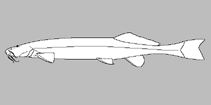
Rückenflossenweichstrahlen (insgesamt) : 11; Afterflossenweichstrahlen: 10 - 11; Wirbelzahl: 39. This species is distinguished from S. mendozensis by the absence of pelvic girdle and fin (vs. present), the number of interopercle odontodes 14-18 (vs. 30-42), the marmorated pigmentation on the body and head (vs. uniformly brown); differs from S. bortayro by the number of branched pectoral–fin rays 7 (vs. 5), the number of total dorsal-fin rays 11 (vs. 9), the anal base fin 10.2-11.7% SL (vs. 8.8-10.2), the supraorbital tendon bone wide (vs. slender), the dark marmorated pigmentation on the body and head (vs. no dark pigmentation in larger individuals), the nasal barbel length 27.3-39.0% SL (vs. 47.1-74.4), the maxillary barbel length 39.5-61.7% SL (vs. 60.5-105.9), the submaxillary barbel length 24.7-41.9% SL (vs. 41.2-57.1), the snout length 40.6-44.4% HL (vs. 35.8-40.5), the number of opercular odontodes 6-8 (vs. 2-4), the number of interopercle
odontodes 14-18 (vs. 9-12); differs from S. huachi by the body depth 10.1-12.6% SL (vs. 12.6-16.5), the supraorbital tendon bone wide (vs. slender), the number of interopercle odontodes 14-18 (vs. 21-28), the number of branchiostegal rays 6 (vs. 7-8), the number of dorsal procurrent caudal-fin rays 14 (vs. 11), the number of ventral procurrent caudal-fin rays 15 (vs. 10); differs from S. gualcamayo by the caudal peduncle length 19.3-21.5% SL (vs. 21.1-23.6), the head depth 9.9-12.2% SL (vs. 9.1-9.8), the interorbital wide 28.3-36.1% HL (vs. 26.1-27.8), the number of branchiostegal rays 6 (vs. 7), the number of dorsal procurrent caudal-fin rays 14 (vs. 11), the number of ventral procurrent caudal-fin rays 15 (vs. 9), the number of total vertebrae 39 (vs. 38); differs from S. leoncitensis by the total number of dorsal-fin rays 11 (vs. 13), the number of dorsal pterygiophore 7 (vs. 8), the number of ribs 16 (vs. 20), the number of total vertebrae 39 (vs. 40), and the number of interopercle odontodes 14-18 (vs. 18-28) (Ref. 122377).
Cross section: oval.
This species was collected from a small creek, approximately 0.50 m deep and 1 to 3 m wide with silt in suspension, the rocky bottom without aquatic vegetation at an elevation of 1,092 m a.s.l. The drainage lies within an endorheic system that experiences torrential hydrological conditions associated with a few but intense summer rains. Captured specimens were hiding under rocks; the usual habit for fishes in other streams in the Andes. The one other species of fish collected at that site was Hatcheria macraei (Siluriformes, Trichomycteridae). The Río Pedernal is impacted by limestone mining operations and many Andean drainage systems are altered by mining activities, including mountain mining/valley fill practices mainly for extraction of minerals (Ref. 122377).
Lebenszyklus und Paarungsverhalten
Geschlechtsreife | Fortpflanzung | Ablaichen | Eier | Fruchtbarkeit | Larven
Fernández, L., E.A. Sanabria and L.B. Quiroga, 2017. Description of Silvinichthys pedernalensis n. sp. (Teleostei, Siluriformes) from the Andean Cordillera of southern South America. An. Bio. Conser. 40(1):1-8. (Ref. 122377)
IUCN Rote Liste Status (Ref. 130435: Version 2025-2 (Global))
Bedrohung für Menschen
Harmless
Nutzung durch Menschen
Tools
Zusatzinformationen
Download XML
Internet Quellen
Schätzungen auf der Grundlage von Modellen
Phylogenetischer Diversitätsindex (Ref.
82804): PD
50 = 0.5078 [Uniqueness, from 0.5 = low to 2.0 = high].
Bayesian length-weight: a=0.00759 (0.00337 - 0.01709), b=3.00 (2.81 - 3.19), in cm total length, based on LWR estimates for this (Sub)family-body shape (Ref.
93245).
Trophische Ebene (Ref.
69278): 3.1 ±0.4 se; based on size and trophs of closest relatives
Anfälligkeit der Fischerei (Ref.
59153): Low vulnerability (10 of 100).
🛈