Classification / Noms
Noms communs | Synonymes | Catalog of Fishes(Genre, Espèce) | ITIS | CoL | WoRMS | Cloffa
>
Cichliformes (Cichlids, convict blennies) >
Cichlidae (Cichlids) > Pseudocrenilabrinae
Etymology: Thysochromis: Greek, thysis, -eos = impulsive + Greek, chromis = a fish, perhaps a perch (Ref. 45335); emili: The species is named for Emil Woolf Kentridge-Young, grandson of William Kentridge and Anne Stanwix, in recognition of their support of research in Africa (Ref. 122428).
Eponymy: Professor Dr Dirk Frans Elisabeth Thys van den Audenerde (d: 1934) is a Belgian ichthyologist and Museum Director. [...] Emil Woolf Kentridge-Young is the grandson of South African artist and animator of c. [...] (Ref. 128868), visit book page.
Environnement : milieu / zone climatique / profondeur / gamme de distribution
Écologie
; eau douce benthopélagique. Tropical
Africa: Noumbi and Kouilou River drainages in Republic of Congo (Ref. 122428).
Taille / Poids / Âge
Maturité: Lm ? range ? - ? cm
Max length : 9.1 cm SL mâle / non sexé; (Ref. 122428)
Description synthétique
Clés d'identification | Morphologie | Morphométrie
Épines dorsales (Total) : 15 - 17; Rayons mous dorsaux (Total) : 9 - 11; Épines anales: 3; Rayons mous anaux: 7 - 9; Vertèbres: 24 - 26. Diagnosis: Thysochromis emili is distinguished from its West African congener, T. ansorgii, by the following combination of characters: fewer scale rows between the pectoral and pelvic-fin origins, 3-4 vs. 5-6; jaw teeth closely spaced and evenly implanted over entire length of both upper and lower jaws vs. widely spaced and unevenly implanted along distal portions; a supraoccipital crest that is continuous with the frontal ridge vs. terminating posterior to frontal ridge (Ref. 122428); a shorter postorbital length, 38.2-41.9% of head length vs. 42.8-46.7%; and a shorter caudal peduncle length, 7.7-11.3% of standard length vs. 11.4-12.7% (Ref. 122428).
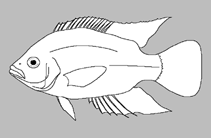
Body shape (shape guide): short and / or deep.
Found in well oxygenated lakes and rivers situated in higher order systems of the Kouilou and Noumbi River basins (Ref. 122428). It occurs over sandy substrate in shallow, less than 0.5 m deep, clear, shoreline waters fringed by abundant overhanging vegetation, deeply undercut banks and root wads (Ref. 122428). It is probably a pair-bonding, cave brooder (Ref. 122428).
Cycle de vie et comportement reproducteur
Maturité | Reproduction | Frai | Œufs | Fécondité | Larves
Walsh, G., A. Lamboj and M.L.J. Stiassny, 2020. Review of the cichlid genus Thysochromis (Teleostei: Ovalentaria) with the description of a new species from the Kouilou Province in the Republic of Congo, west-Central Africa. J. Fish Biol. 2020:96 (5):1176-1185. (Ref. 122428)
Statut dans la liste rouge de l'IUCN (Ref. 130435: Version 2025-2 (Global))
Menace pour l'homme
Harmless
Utilisations par l'homme
Outils
Articles particuliers
Télécharger en XML
Sources Internet
Estimations basées sur des modèles
Indice de diversité phylogénétique (Réf.
82804): PD
50 = 0.6250 [Uniqueness, from 0.5 = low to 2.0 = high].
Bayesian length-weight: a=0.01905 (0.00846 - 0.04293), b=3.01 (2.82 - 3.20), in cm total length, based on LWR estimates for this (Sub)family-body shape (Ref.
93245).
Niveau trophique (Réf.
69278): 3.3 ±0.4 se; based on size and trophs of closest relatives
Résilience (Réf.
120179): Haut, temps minimum de doublement de population inférieur à 15 mois (Preliminary K or Fecundity.).
Vulnérabilité de la pêche (Ref.
59153): Low vulnerability (10 of 100).
🛈