Classificazione / Nomi
Nomi Comuni | Sinonimi | Catalog of Fishes(Genere, Specie) | ITIS | CoL | WoRMS | Cloffa
>
Siluriformes (Catfishes) >
Trichomycteridae (Pencil or parasitic catfishes) > Trichomycterinae
Etymology: Scleronema: Greek, skleros = hard + Greek,nema = filament (Ref. 45335); guapa: Name from a regional adjective used to describe a beautiful person (‘guapa’), an allusion to the beauty of the new species.
Ambiente: milieu / zona climatica / distribuzione batimetrica / gamma di distribuzione
Ecologia
; acqua dolce demersale. Tropical
South America: Brazil.
Dimensione / Peso / Età
Maturità: Lm ? range ? - ? cm
Max length : 4.2 cm SL maschio/sesso non determinato; (Ref. 122319)
Breve descrizione
Chiavi di identificazione | Morfologia | Morfometria
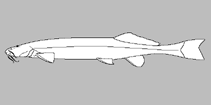
Raggi dorsali molli (totale) : 7 - 10; Raggi anali molli: 5 - 6; Vertebre: 35 - 36. This species is distinguished from all its congeners by having the lateral surface of body with diffuse, scattered brown spots, sometimes grouped forming irregular and small marks at midlateral line (vs. lateral surface of body with a midlateral line of black or brown rounded blotches); further differs macanuda and operculatum by hving the maxillary barbel longer than half-length of the head (vs. smaller than half-length of the head); tips of pectoral-fin rays not extending beyond the interadial membrane (vs. extending beyond the interadial membrane); skin flap in the posterior margin of the opercle rounded and short (vs. skin flap pointed and long); fleshy flap at the base of the maxillary barbel located posteriorly, thin, restricted to the maxilla and distal margin is rounded (vs. fleshy flap located anteriorly, thick, prolonged up to the snout and with distal margin straight); caudal fin uniformly brown (vs. caudal fin with a transversal black bar distally); differs further from ibirapuita, milonga and teiniagua by having the pore s3 of the supraorbital line of the laterosensory system (vs. pore s3 absent) (Ref. 122319).
Cross section: oval.
This species inhabits rivers and streams, with fine sandy bottoms. Often collected syntopically with S. operculatum (Ref. 112319).
Ciclo vitale e comportamento di accoppiamento
Maturità | Riproduzione | Deposizione | Uova | Fecondità | Larve
Ferrer, J. and L.R. Malabarba, 2020. Systematic revision of the Neotropical catfish genus Scleronema (Siluriformes: Trichomycteridae), with descriptions of six new species from Pampa grasslands. Neotrop. Ichthyol. 18(2):1-81. (Ref. 122319)
Stato della Lista Rossa IUCN (Ref. 130435: Version 2025-2 (Global))
Minaccia per l'uomo
Harmless
Usi umani
Strumenti
Rapporti speciali
Scarica XML
Fonti Internet
Stime basate su modelli
Indice di diversità filogenetica (Fonte Biblio.
82804): PD
50 = 0.5020 [Uniqueness, from 0.5 = low to 2.0 = high].
Bayesian length-weight: a=0.00759 (0.00337 - 0.01709), b=3.00 (2.81 - 3.19), in cm total length, based on LWR estimates for this (Sub)family-body shape (Ref.
93245).
Livello trofico (Fonte Biblio.
69278): 3.1 ±0.4 se; based on size and trophs of closest relatives
Vulnerabilità della pesca (Ref.
59153): Low vulnerability (10 of 100).
🛈