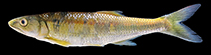
Classificazione / Nomi
Nomi Comuni | Sinonimi | Catalog of Fishes(Genere, Specie) | ITIS | CoL | WoRMS | Cloffa
>
Cypriniformes (Carps) >
Danionidae (Danios) > Chedrinae
Etymology: marqueti: The species name, marqueti, is in honour of Jean-Pierre Marquet, former technical assistant of the Belgian Technical Cooperation project 'PRODEPAAK', in recognition of his remarkable efforts in fish collecting and who provided logistic support for the Katanga Expedition 2012 which resulted in the discovery of this new species (Ref. 122357).
Eponymy: Jean-Pierre Marquet was formerly technical assistant of the BTC (Belgian Technical Cooperation) project ‘PRODEPAAK’ (Projet de Développement de la Pêche Artisanale et de l’Aquaculture au Katanga, 2008–2013). [...] (Ref. 128868), visit book page.
Ambiente: milieu / zona climatica / distribuzione batimetrica / gamma di distribuzione
Ecologia
; acqua dolce benthopelagico; pH range: 7.0 - 8.4; distribuzione batimetrica 1 - 2 m (Ref. 122357). Tropical; 18°C - 28°C (Ref. 122357)
Africa: right bank tributaries of Upper Congo River and affluents of Lake Tanganyika in Democratic Republic of the Congo, Burundi and Tanzania (Ref. 122357).
Dimensione / Peso / Età
Maturità: Lm ? range ? - ? cm
Max length : 19.7 cm SL maschio/sesso non determinato; (Ref. 122357)
Breve descrizione
Chiavi di identificazione | Morfologia | Morfometria
Spine dorsali (totale) : 0; Raggi dorsali molli (totale) : 12; Spine anali: 0; Raggi anali molli: 16 - 17; Vertebre: 40 - 41. Diagnosis: Within the Congo basin, Raiamas marqueti can be distinguished from R. batesii, R. kheeli and R. moorii by a lower number of lateral line scales, 45-48 vs. 68-70, 65-68 and 54-61 respectively; from R. longirostris by a greater head width, 37-45% of head length vs. 31%, and a deeper body, 18.8-23.3% of standard length vs. 16.5%; from R. buchholzi and R. christyi by the absence of a large dark spot at the base of the caudal fin vs. presence, a longer dorsal-fin base, 12.5-14.0% of standard length vs. 10.1-12.0% and 10.4-11.6% respectively, and a shallower head depth, 49.5-55.9% of standard length vs. 56.5-61.8% (Ref. 122357). Furthermore, it is distinguished from the phenotypically similar species R. intermedius and R. brachyrhabdotos by a shallower body, 18.8-23.3% of standard length vs. 25.2-28.8% and 23.6-29.8% respectively, and a more or less horizontal predorsal profile vs. convex predorsal profile; and from R. salmolucius by a shorter head, 27.0-30.1% of standard length vs. 30.2-33.6%, and the short distance between nostril and eye, 6-7% of head length vs. 5-6%, overlap due to negative allometry, and the narrower width of the first two bars posterior to the pectoral fin covering only 1.5-2.0 lateral line scales vs. wide bars covering 2.5-3.0 lateral line scales (Ref. 122357). Outside the Congo basin, Raiamas marqueti is distinguished from all other species, except R. ansorgii, R. nigeriensis and R. senegalensis, by a intermediate high number of lateral line scales, 45-48 vs. 36-38 in R. levequei, 58-63 in R. scarciensis and 39-42 in R. steindachneri; from R. ansorgii by the insertion of the dorsal fin slightly behind the pelvic-fin insertion, about three or four lateral line scales between the verticals through the anterior base of the dorsal fin and the pelvic-fin insertion vs. six or seven scales; from R. nigeriensis by a longer head, 27.0-30.1% of standard length vs. 18.6-25.0%, and a shorter eye diameter, 20-26% of head length vs. 29-36%; and from R. senegalensis by a higher number of branched dorsal-fin rays, 9 vs. 8 (Ref. 122357).
Body shape (shape guide): elongated.
Found in rapids, but also rivers with sandy substrate (Ref. 122357).
Ciclo vitale e comportamento di accoppiamento
Maturità | Riproduzione | Deposizione | Uova | Fecondità | Larve
Katemo Manda, B., J. Snoeks, A. Chocha Manda and E. Vreven, 2018. Hidden species diversity in Raiamas salmolucius (Teleostei: Cyprinidae) from the Congo basin: two new species based on morphometric evidence. Ichthyol. Explor. Freshwat. 28(4):345-363. (Ref. 122357)
Stato della Lista Rossa IUCN (Ref. 130435: Version 2025-2 (Global))
Minaccia per l'uomo
Harmless
Usi umani
Strumenti
Rapporti speciali
Scarica XML
Fonti Internet
Stime basate su modelli
Indice di diversità filogenetica (Fonte Biblio.
82804): PD
50 = 0.5000 [Uniqueness, from 0.5 = low to 2.0 = high].
Bayesian length-weight: a=0.00589 (0.00280 - 0.01240), b=3.00 (2.82 - 3.18), in cm total length, based on LWR estimates for this (Sub)family-body shape (Ref.
93245).
Livello trofico (Fonte Biblio.
69278): 3.4 ±0.4 se; based on size and trophs of closest relatives
Resilienza (Fonte Biblio.
120179): Medio, tempo minimo di raddoppiamento della popolazione 1.4 - 4.4 anni (Preliminary K or Fecundity.).
Vulnerabilità della pesca (Ref.
59153): Low vulnerability (14 of 100).
🛈