Klassifizierung / Names
Namen | Synonyme | Catalog of Fishes(Gattung, Arten) | ITIS | CoL | WoRMS | Cloffa
>
Perciformes/Serranoidei (Groupers) >
Anthiadidae (Fairy basslets or Streamer basses)
Etymology: Xenanthias: Although Regan (1908) did not specific the allusion of Xenanthias, the name is probably the combination of ξένος (xénos, meaning strange or foreign), and anthias, possibly an indication to a strange anthias; polygonius: Named for the orange rhomboid-shaped polygons in parallel rows along the lateral midline that distinguish it from all its congeners; Noun in apposition.
Umwelt: Milieu / Klimazone / Tiefenbereich / Verbreitungsgebiet
Ökologie
seewasser riff-verbunden; tiefenbereich 105 - 120 m (Ref. 122130). Tropical
Pacific Ocean: French Polynesia, Tahiti and the Marshall Is.
Größe / Gewicht / Alter
Geschlechtsreife: Lm ? range ? - ? cm
Max length : 3.2 cm SL Männchen/unbestimmt; (Ref. 122130)
Kurzbeschreibung
Bestimmungsschlüssel | Morphologie | Morphometrie
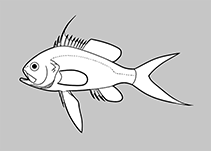
Rückenflossenstacheln (insgesamt) : 10; Rückenflossenweichstrahlen (insgesamt) : 16; Afterflossenstacheln: 3; Afterflossenweichstrahlen: 7; Wirbelzahl: 26. This species is distinguished from its congeners by the following set of characters: : colouration when alive, in particular the two rows of orange rhomboid-shaped polygons on the lateral part of the body and an elongated yellow and white third dorsal spine; D X,16; pectoral-fin rays 14, all unbranched; vertebrae 10 + 16; continuous lateral line with 27-30 tubed scales; circumpeduncular scales 10-11; preopercle without antrorse spines (Ref. 122130).
Cross section: compressed.
Collected (with hand nets) in highly complex reefs predominantly covered by coralline algae and sponges and crevices of steep reef walls, indicating that this species probably has a wider Pacific distribution and all known individuals have been observed or collected at mesophotic depths, suggesting as with most of its congeners, this species does not inhabit shallow coral reef habitats (Ref. 122130).
Lebenszyklus und Paarungsverhalten
Geschlechtsreife | Fortpflanzung | Ablaichen | Eier | Fruchtbarkeit | Larven
Shepherd, B., T.A.Y. Phelps, H.T. Pinheiro, C.R. Rocha and L.A. Rocha, 2020. Two new species of Plectranthias (Teleostei, Serranidae, Anthiadinae) from mesophotic coral ecosystems in the tropical Central Pacific. ZooKeys 941:145-161. (Ref. 122130)
IUCN Rote Liste Status (Ref. 130435: Version 2025-2 (Global))
Bedrohung für Menschen
Harmless
Nutzung durch Menschen
Fischereien: nicht kommerziell
Tools
Zusatzinformationen
Download XML
Internet Quellen
Schätzungen auf der Grundlage von Modellen
Phylogenetischer Diversitätsindex (Ref.
82804): PD
50 = 0.5005 [Uniqueness, from 0.5 = low to 2.0 = high].
Bayesian length-weight: a=0.01413 (0.00621 - 0.03212), b=3.00 (2.81 - 3.19), in cm total length, based on LWR estimates for this (Sub)family-body shape (Ref.
93245).
Trophische Ebene (Ref.
69278): 3.5 ±0.5 se; based on size and trophs of closest relatives
Widerstandsfähigkeit (Ref.
120179): hoch, Verdopplung der Population dauert weniger als 15 Monate. (Preliminary K or Fecundity.).
Anfälligkeit der Fischerei (Ref.
59153): Low vulnerability (10 of 100).
🛈