Classificatie / Namen
Lokale namen | Synoniemen | Catalog of Fishes(Genus, Soort(en)) | ITIS | CoL | WoRMS | Cloffa
>
Cyprinodontiformes (Rivulines, killifishes and live bearers) >
Nothobranchiidae (African rivulines)
Etymology: Nothobranchius: Greek, nothos = false + Greek, brangchia = gill (Ref. 45335); angelae: The specific name is given in honour of Angela Watters, wife of Brian R. Watters, in recognition of her unwavering support for his many field trips to Africa to study fishes of the genus Nothobranchius, during which she also very capably maintained the fishes in the tanks of his large fish room; a noun in genitive (Ref. 122068).
Eponymy: Angela Watters is the wife of the first author, Brian Watters (q.v.), who honoured her for ‘unwavering support’ for his many field trips to Africa to study killifish. (Also see Watters) (Ref. 128868), visit book page.
Milieu: milieu / Klimaatzone / Diepte / verspreidingsgebied
Ecologie
; zoet water benthopelagisch. Tropical
Africa: Bahi Swamp and associated drainage systems, including Bubu River system in north-central Tanzania (Ref. 122068), and also marshy areas in the extreme north-western headwaters of the Ruaha River system (Ref. 122068).
Grootte / Gewicht / Leeftijd
Maturiteit: Lm ? range ? - ? cm
Max length : 4.4 cm SL mannelijk / geslacht onbekend; (Ref. 122068); 3.3 cm SL (female)
Korte beschrijving
Determinatiesleutels | Morfologie | Morfometrie
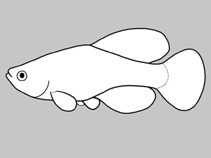
Dorsale stekels (totaal) : 0; Dorsale zachte stralen (totaal) : 15 - 16; Anale stekels: 0; Anale zachte stralen: 16 - 18. Diagnosis: Nothobranchius angelae is distinguished from all other species of the genus by the following combination of characters in males: body colouration light blue to blue-green with red-brown or dark grey scale margins; anal fin light blue-grey to yellow-grey with irreguar brown spots, with narrow brown submedial band, slender white to pale cream medial band and broad black distal band; caudal fin light brown-grey with irregular dark brown spots proximally, followed by a narrow dark brown medial band, a slender white subdistal band and a slender to broad black distal band; pelvic fins light blue-grey to blue-green, with broad white to cream medial band and narrow black distal band (Ref. 122068). Furthermore, it differs from the other members of the Nothobranchius taeniopygus species group in central and western Tanzania by a postorbital length 55-63% of head length vs. 43-54%; and caudal peduncle length 132-137% of its depth vs. 119-130% and 140-169% (Ref. 122068).
Body shape (shape guide): fusiform / normal; Cross section: compressed.
Found in seasonal pools and marshes (Ref. 122068).
Levenscyclus en paargedrag
Maturiteit | Voortplanting | Paaien | Eieren | Fecunditeit | Larven
Watters, B.R., B. Nagy, P.D.W. van der Merwe, F.P.D. Cotteril and D.U. Bellstedt, 2019. Review of the Nothobranchius taeniopygus species group from central and western Tanzania with descriptions of five new species and redescription of Nothobranchius taeniopygus (Teleostei: Nothobranchiidae). Ichthyol. Explor. Freshwat. 29(3):239-278. (Ref. 122068)
Status op de Rode Lijst van het IUCN (Ref. 130435: Version 2025-2 (Global))
Gevaar voor de mens
Harmless
Gebruik door de mens
Tools
Speciale rapporten
Download XML
Internetbronnen
Schattingen op basis van modellen
Fylogenetische diversiteitsindex (Ref.
82804): PD
50 = 0.5000 [Uniqueness, from 0.5 = low to 2.0 = high].
Bayesian length-weight: a=0.00603 (0.00250 - 0.01453), b=3.13 (2.93 - 3.33), in cm total length, based on LWR estimates for this (Sub)family-body shape (Ref.
93245).
Trofisch niveau (Ref.
69278): 3.2 ±0.4 se; based on size and trophs of closest relatives
Kwetsbaarheid van de visserij (Ref.
59153): Low vulnerability (10 of 100).
🛈