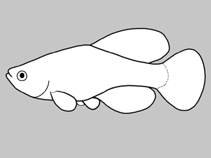
Clasificación / Nombres
Nombres comunes | Sinónimos | Catalog of Fishes(Género, Especie) | ITIS | CoL | WoRMS | Cloffa
>
Cyprinodontiformes (Rivulines, killifishes and live bearers) >
Nothobranchiidae (African rivulines)
Etymology: Nothobranchius: Greek, nothos = false + Greek, brangchia = gill (Ref. 45335); insularis: From the Latin insularis, meaning pertaining to an island and referring to the occurrence of this species on Mafia Island (Ref. 122074).
Entorno: milieu / zona climática / rango de profundidad / gama de distribución
Ecología
; agua dulce bentopelágico. Tropical
Africa: northern part of Mafia Island in Tanzania (Ref. 122074).
Tamaño / Peso / Edad
Madurez: Lm ? range ? - ? cm
Max length : 5.3 cm SL macho / no sexado; (Ref. 122074); 5.0 cm SL (female)
Descripción breve
Claves de identificación | Morfología | Morfometría
Espinas dorsales (total) : 0; Radios blandos dorsales (total) : 15 - 16; Espinas anales: 0; Radios blandos anales: 16 - 18. Diagnosis: Nothobranchius insularis is distinguished from all species of the N. melanospilus group, except N. lucius, in possessing snout pointed in lateral view, jaws moderately long vs. snout blunt to weakly pointed, jaws short; caudal fin, in males, with broad dark grey to black band on the posterior margin vs. narrow; presence, in females, of dark dots over the whole flank vs. dark dots when present restricted to the posterior portion of the flank (Ref. 122074). It differs from N. lucius by having inner premaxillary teeth smaller than teeth of the outer premaxillary tooth row vs. larger; caudal fin subtruncate in males vs. rounded; in females, flank dark dots are vertically elongated and often arranged in oblique rows vs. dots rounded, arranged in horizontal rows; unpaired fins, in females, with dark grey dots when present restricted to their basal portion vs. extending over most fin; caudal, pectoral and pelvic fins shorter, caudal fin length 26.9-29.6% of standard length in males and 22.8-27.4% of standard length in females of N. insularis, vs. 31.3-34.9% of standard length in males and 30.3-32.9% of standard length in females of N. lucius; pectoral-fin length 17.1-21.8% of standard length in males and 14.2-19.3% of standard length in females, vs. 22.2-24.5% of standard length and 20.2-24.6% of standard length, respectively; pelvic-fin length 8.6-11.0% of standard length in males and 9.6-11.0% of standard length in females, vs. 11.6-13.1% of standard length and 11.5-13.0% of standard length, respectively; and three neuromasts in the posterior section of the anterior supraorbital series vs. two (Ref. 122074).
Body shape (shape guide): fusiform / normal; Cross section: compressed.
Ciclo vital y comportamiento de apareamiento
Madurez | Reproducción | Puesta | Huevos | Fecundidad | Larva
Costa, W.J.E.M., 2017. Redescription of Nothobranchius lucius and description of a new species from Mafia Island, eastern Tanzania (Cyprinodontiformes, Aplocheilidae). Zoosyst. Evol. 93(1):35-44. (Ref. 122074)
Situación en la Lista Roja de la UICN (Ref. 130435: Version 2025-2 (Global))
Amenaza para el ser humano
Harmless
Usos humanos
Herramientas
Informes especiales
Descargar XML
Fuentes de Internet
Estimaciones basadas en modelos
Índice de diversidad filogenética (Referencia
82804): PD
50 = 0.5000 [Uniqueness, from 0.5 = low to 2.0 = high].
Bayesian length-weight: a=0.00603 (0.00250 - 0.01453), b=3.13 (2.93 - 3.33), in cm total length, based on LWR estimates for this (Sub)family-body shape (Ref.
93245).
Nivel trófico (Referencia
69278): 3.2 ±0.4 se; based on size and trophs of closest relatives
Vulnerabilidad pesquera (Ref.
59153): Low vulnerability (10 of 100).
🛈