Klassifizierung / Names
Namen | Synonyme | Catalog of Fishes(Gattung, Arten) | ITIS | CoL | WoRMS | Cloffa
Umwelt: Milieu / Klimazone / Tiefenbereich / Verbreitungsgebiet
Ökologie
seewasser demersal; tiefenbereich 0 - 27 m (Ref. 93135). Tropical
Western Indian Ocean: northern Red Sea.
Größe / Gewicht / Alter
Geschlechtsreife: Lm ? range ? - ? cm
Max length : 16.9 cm SL Männchen/unbestimmt; (Ref. 93135); 21.6 cm SL (female)
Kurzbeschreibung
Bestimmungsschlüssel | Morphologie | Morphometrie
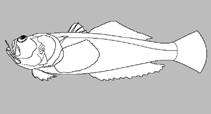
Rückenflossenstacheln (insgesamt) : 4; Rückenflossenweichstrahlen (insgesamt) : 13; Afterflossenweichstrahlen: 13; Wirbelzahl: 25. This species is distinguished by the following characters: D IV + 13; pectoral rays 18; oblique scale rows on midside of body 37-41; body above lateral line anterior to second dorsal fin no scales; body depth of adult at anal-fin origin 3.6-4.05 in SL; the head broad and flat dorsally, the width 2.5-2.8 in SL; rugose bones dorsally on head; occipital lobes are not developed as knobs; large cleithral spine, slightly angled dorsally; 3.85-4.7 in head length; supracleithrum does not form a distinct spine posteriorly; small spines 5-7 ventrally on preopercle; blunt preorbital spines 3-5; small eyes its orbit diameter 6.45-7.1 in head length; lingual lure broadly triangular and flat at the base, with long cirri on each side, narrowing to a slender ribbon-like filament with short cirri on edges, its length is half the distance separating cleithral spines; dorsal fins are narrowly separated; margin of second dorsal fin straight; caudal fin slightly rounded. Colouration: in life it is light gray-brown, grading to white ventrally, the dorsal half of body with irregular longitudinal rows of dark brown spots of about eye size, many rosette-like, and scattered dark brown dots, especially posteriorly; head with dark dots dorsally; the first dorsal fin largely black while the second dorsal and anal fins have translucent membranes, the dorsal rays and posterior anal rays dotted with dark brown, the margin white; caudal fin dark gray with black dots on rays, the posterior margin white (Ref. 93135).
Cross section: flattened.
Collected using rotenone in cove, edge of precipitous reef with numerous caves, rock and coral ledge, over sand and patches of segrasses (Ref. 93135).
Lebenszyklus und Paarungsverhalten
Geschlechtsreife | Fortpflanzung | Ablaichen | Eier | Fruchtbarkeit | Larven
Randall, J.E. and R.J. Arnold, 2012. Uranoscopus rosette, a new species of stargazer (Uranoscopidae: Trachinoidei) from the Red Sea. aqua, Int. J. Ichthyol. 18(4):209-218. (Ref. 93135)
IUCN Rote Liste Status (Ref. 130435: Version 2025-2 (Global))
Bedrohung für Menschen
Harmless
Nutzung durch Menschen
Tools
Zusatzinformationen
Download XML
Internet Quellen
Schätzungen auf der Grundlage von Modellen
Phylogenetischer Diversitätsindex (Ref.
82804): PD
50 = 0.5000 [Uniqueness, from 0.5 = low to 2.0 = high].
Bayesian length-weight: a=0.00794 (0.00315 - 0.02004), b=3.09 (2.89 - 3.29), in cm total length, based on LWR estimates for this Genus-body shape (Ref.
93245).
Trophische Ebene (Ref.
69278): 4.1 ±0.7 se; based on size and trophs of closest relatives
Widerstandsfähigkeit (Ref.
120179): mittel, Verdopplung der Population dauert 1,4 - 4,4 Jahre. (Preliminary K or Fecundity.).
Anfälligkeit der Fischerei (Ref.
59153): Low vulnerability (16 of 100).
🛈