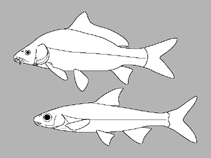
Klassificering / Namn
Populärnamn | synonymer | Catalog of Fishes(Släkte, Arter) | ITIS | CoL | WoRMS | Cloffa
>
Cypriniformes (Carps) >
Cyprinidae (Minnows or carps) > Labeoninae
Etymology: Garra: Name based on a vernacular Indian name (Hamilton, 1822:343, Ref. 1813); a fish living in mud (Ref. 128817); jamila: Named after the Arabian word "jamila", meaning "beautiful", in reference to its bright colouration on body and fins of this pretty fish; a Latinised adjective (Ref. 122047).
Miljö: miljö / Klimatzon / djupintervall / distributionsområde
Ekologi
; sötvatten bentopelagisk. Tropical
Africa: Atbara River, tributary of Nile River, in Sudan (Ref. 122047).
Storlek / Vikt / Ålder
Könsmognad: Lm ? range ? - ? cm
Max length : 6.3 cm SL hane/ej könsbestämd; (Ref. 122047)
Kort beskrivning
Bestämningsnycklar | Morfologi | Morfometri
Taggstrålar i ryggfenan (totalt) : 0; Mjukstrålar i ryggfenan (totalt) : 9 - 11; Taggstrålar i analfenan: 0; Mjukstrålar i analfenan: 8; Ryggkotor: 35 - 37. Diagnosis: Garra jamila differs from all other African Garra species, except G. napata and G. ethelwynnae, in an asquamate area along the dorsum which exceeds well beyond the dorsal fin insertion and laterally onto flanks and thus accounting for an incomplete scale row count of only 2 to 2.5 scales between dorsal fin insertion and the lateral line vs. 3 or more scales (Ref. 122047). It is distinguished from G. ethelwynnae from the Damas River basin in Eritrea by: an asquamate postpelvic area vs. squamate, and more scales in lateral line, 34-38 vs. 32-34 (Ref. 122047). It is distinguished from G. napata from the Main Nile basin by its well-developed disc, type C, with prominent free posterior flap vs. intermediate, type B, with very small or absent posterior flap; crenate upper lip vs. smooth; its vivid red colouration of the distal end of the anal fin when alive vs. anal fin lacking any red colours; a small dark humeral spot usually as large or smaller than the red postopercular spot vs. humeral spot twice as large as postopercular spot; fixed specimens with very dark blackish to brown colouration on back ad contrasting light belly vs. entire body grey beige (Ref. 122047). It is distinguished from G. vinciguerrae by a naked predorsal area that exceeds laterally beyond dorsal fin vs. at least single, irregular predorsal scales present on nape; middle of dorsal fin membrane with prominent dark horizontal band vs. no such band; from G. sannarensis by its well-developed disc, type C, vs. intermediate, type B disc, and posterior disc flap rounded and of equal width vs. caudally slightly extended, oval shaped flap with bulky middle; from G. sp. "White Nile" in having prominent stout short barbels, not reaching onto lower lip pad when flexed inwards vas. barbels nearly touching each other when flexed inwards (Ref. 122047).
Body shape (shape guide): elongated.
Livscykel och parningsbeteende
Könsmognad | Reproduktion | Lek | Ägg | Fekunditet | Larver
Moritz, T., N. Straube and D. Neumann, 2019. The Garra species (Cyprinidae) of the Main Nile basin with description of three new species. Cybium 43(4):311-329. (Ref. 122047)
Status på IUCN:s rödlista (Ref. 130435: Version 2025-2 (Global))
Hot mot människor
Harmless
Mänskliga användningsområden
Fiskeri: saknar intresse
Verktyg
Särskilda rapporter
Ladda ner XML
Internet-källor
Uppskattningar baserade på modeller
Index för fylogenetisk mångfald (Ref.
82804): PD
50 = 0.5000 [Uniqueness, from 0.5 = low to 2.0 = high].
Bayesian length-weight: a=0.00794 (0.00359 - 0.01758), b=3.04 (2.87 - 3.21), in cm total length, based on LWR estimates for this Genus-body shape (Ref.
93245).
Resiliens (Ref.
120179): Hög, lägsta populationsfördubblingstid mindre än 15 månader (Preliminary K or Fecundity.).
Sårbarhet i fisket (Ref.
59153): Low vulnerability (10 of 100).
🛈