Klassifizierung / Names
Namen | Synonyme | Catalog of Fishes(Gattung, Arten) | ITIS | CoL | WoRMS | Cloffa
>
Cyprinodontiformes (Rivulines, killifishes and live bearers) >
Procatopodidae (African lampeyes) > Procatopodinae
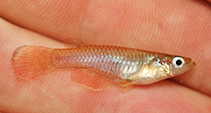
Etymology: pepo: The name pepo refers to the orange colour of the dorsum and unpaired fins in males, that resembles the colour of the pumpkin Cucurbita pepo (Ref. 122044).
Umwelt: Milieu / Klimazone / Tiefenbereich / Verbreitungsgebiet
Ökologie
; süßwasser pelagisch. Tropical
Africa: Lower Congo River near Inga in Democratic Republic of Congo (Ref. 122044).
Größe / Gewicht / Alter
Geschlechtsreife: Lm ? range ? - ? cm
Max length : 3.0 cm SL Männchen/unbestimmt; (Ref. 122044)
Kurzbeschreibung
Bestimmungsschlüssel | Morphologie | Morphometrie
Rückenflossenstacheln (insgesamt) : 0; Rückenflossenweichstrahlen (insgesamt) : 5 - 6; Afterflossenstacheln: 0; Afterflossenweichstrahlen: 14 - 17; Wirbelzahl: 25 - 26. Diagnosis: Poropanchax pepo is distinguished from all procatopodids except other Poropanchax by: the presence of a slightly curved, posteriorly directed, distal maxillary process vs. straight, anteromedially directed or deeply constricted; and the presence of a slender dentary vs. robust dentary (Ref. 122044). It is distinguished from all congeners by: a relative position of the first dorsal-fin ray to anal-fin rays of 11-14 vs. 5-10; the presence of rounded anal and dorsal fins in males vs. pointed; the presence of a dark humeral blotch in males vs. absence; and the absence of a sharp ventral process on the basipterygium vs. presence (Ref. 122044). It is further distinguished from all congeners except P. scheeli, by the presence of an open anterior supraorbital system vs. closed, and by the absence of bright bluish flank bands in males (Ref. 122044). It is similar to P. rancureli and distinct from other congeners in lacking filamentous pelvic fins vs. pelvic filaments present; other features not unique but useful for identification of Poropanchax pepo are the absence of a dark brown blotch on the lower jaw and preorbital area and the presence of a dark marginal band on the caudal-fin lobes (Ref. 122044).
Body shape (shape guide): fusiform / normal; Cross section: compressed.
Found in a stagnant channel, with sand and bolders, located approximately 180 meters from the main channel of the Congo River (Ref. 122044).
Lebenszyklus und Paarungsverhalten
Geschlechtsreife | Fortpflanzung | Ablaichen | Eier | Fruchtbarkeit | Larven
van der Zee, J.R., K. Bernotas, P.H.N. Bragança and M.L.J. Stiassny, 2019. An unexpected new Poropanchax (Cyprinodontiformes, Procatopodidae) from the Kongo Central Province, Democratic Republic of Congo. Am. Mus. Novit. 3941:1-12. (Ref. 122044)
IUCN Rote Liste Status (Ref. 130435: Version 2025-2 (Global))
Bedrohung für Menschen
Harmless
Nutzung durch Menschen
Tools
Zusatzinformationen
Download XML
Internet Quellen
Schätzungen auf der Grundlage von Modellen
Phylogenetischer Diversitätsindex (Ref.
82804): PD
50 = 0.5156 [Uniqueness, from 0.5 = low to 2.0 = high].
Bayesian length-weight: a=0.00562 (0.00224 - 0.01412), b=3.07 (2.85 - 3.29), in cm total length, based on LWR estimates for this (Sub)family-body shape (Ref.
93245).
Trophische Ebene (Ref.
69278): 3.1 ±0.4 se; based on size and trophs of closest relatives
Anfälligkeit der Fischerei (Ref.
59153): Low vulnerability (10 of 100).
🛈