Myxini (mixinas) (hagfishes) >
Myxiniformes (Hagfishes) >
Myxinidae (Hagfishes) > Eptatretinae
Etymology: Eptatretus: hepta (Gr.), seven; tretos (Gr.), perforated (i.e., with holes), referring to seven gill apertures on what would later be described as Homea banksii (=E. cirrhatus) [range within genus is 6-14 pairs of gill apertures] (See ETYFish); wandoensis: -ensis, Latin suffix denoting place: Wando-gun, Jeollanam-do, Republic of Korea, type locality (See ETYFish).
Taxonomic Remarks
Formally known only from the type-series in 2020 but was initially confused with Eptatretus burgeri because it may have been considered a morphological variation of Eptatretus burgeri, due to the presence of five gill apertures (Ref. 122037).
Ambiente: milieu / zona climática / intervalo de profundidade / gama de distribuição
Ecologia
marinhas demersal; intervalo de profundidade 60 - 80 m (Ref. 122037). Temperate; 35°N - 33°S, 126°E - 128°E (Ref. 122037)
Northwest Pacific: Sea of Korea / Sea of Japan / East Sea.
Tamanho / Peso / Idade
Maturidade: Lm ? range ? - ? cm
Max length : 29.2 cm TL (female)
Descrição breve
Chaves de identificação | Morfologia | Morfometria
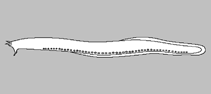
This species is distinguished by the following characters: 5 pairs of gill apertures; conspicuous eyespots; fused cusps 3/2, with total cusps, 40-43; gill pouch (GP) one at end of dental muscle; total slime pores 74-82 (prebranchial 14-18; branchial 4; trunk 46-49; tail 9-11); branchial length 5.2%-6.2% of TL; pharyngocutaneous duct confluent with the last gill aperture; ventral artery splitting at ca. 3-4 GP. Colour when fresh: body uniformly dark brown or purplish dorsally and white ventrally; white mid-dorsal line distinct, beginning from upper region of the first prebranchial slime pore to around the tail (Ref. 122037).
Body shape (shape guide): elongated; Cross section: compressed.
A female specimen (29.0 cm TL) was found with approximately 20 developing eggs, without terminal anchor filaments or hooks, and each egg measures approximately 4-7 mm in diameter and 10-12 mm in length (Ref. 122037).
Ciclo de vida e comportamento de acasalamento
Maturidade | Reprodução | Desova | Ovos | Fecundidade | Larvas
A female specimen of 29.0 cm TL carries approximately 20 developing eggs, which have no terminal anchor filaments or hooks; each egg approximately 4-7 mm in diameter and 10-12 mm in length. Another one of 29.2 com TL had none.
Song, Y.S. and J.-K. Kim, 2020. A new species of hagfish, Eptatretus wandoensis sp. nov. (Agnatha, Myxinidae), from the southwestern Sea of Korea. ZooKeys 926: 81-94. (Ref. 122037)
Categoria na Lista Vermelha da IUCN (Ref. 130435: Version 2025-2 (Global))
Ameaça para o homem
Harmless
Utilização humana
Pescarias: sem interesse
Ferramentas
Relatórios especiais
Descarregue XML
Fontes da internet
Estimativas baseadas em modelos
Índice de diversidade filogenética (Ref.
82804): PD
50 = 0.5000 [Uniqueness, from 0.5 = low to 2.0 = high].
Bayesian length-weight: a=0.00389 (0.00180 - 0.00842), b=3.12 (2.94 - 3.30), in cm total length, based on all LWR estimates for this body shape (Ref.
93245).
Nível Trófico (Ref.
69278): 4.0 ±0.7 se; based on size and trophs of closest relatives
Resiliência (Ref.
120179): Médio, tempo mínimo de duplicação da população 1,4 - 4,4 anos (Preliminary K or Fecundity.).
Vulnerabilidade da pesca (Ref.
59153): Low vulnerability (19 of 100).
🛈