This website uses cookies to enhance your browsing experience and ensure the functionality of our site. For more detailed information about the types of cookies we use and how we protect your privacy, please visit our Privacy Information page.
×
Cookie Settings
This website uses different types of cookies to enhance your experience. Please select your preferences below:
> Cypriniformes (Carps) > Danionidae (Danios) > Chedrinae
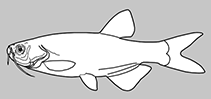
Etymology: kinondo:The specific epithet of the new species 'kinondo' is the Ameru language word for 'silver' and is in reference to the bright silver colour of the sides of Neobola kinondo (Ref. 121710).
背面の脊椎 (合計) : 0; 背鰭 (合計) : 7 - 9; 肛門の骨: 0; 臀鰭: 18 - 23. Diagnosis: Neobola kinondo is readily diagnosed from its presumed closest relative, N. fluviatilis, by higher counts of lateral line scales, 38-47 vs. 37-41; predorsal scales, 20-27 vs. 19-20; and caudal peduncle circumferential scales, 12-16 vs. 10-13; and lower counts of transverse scales, 7-11 vs. 8-10; principal dorsal-fin rays, 7-9 vs. 8-9; and principal anal-fin rays, 18-23 vs. 20-24 (Ref. 121710). Combining lateral line scales and pre-dorsal scales completely separates Neobola kinondo from N. fluviatilis; Neobola kinondo has a combined count of 61 or more scales and N. fluviatilis has fewer than 61 lateral line and predorsal scales (Ref. 121710). Neobola kinondo differs from N. bottegi by its higher numbers of lateral line scales, 38-45 vs. 37-40; and principal anal-fin rays, 18-23 vs. 14-18; and a more triangular pectoral axial scale vs. more lanceolate in N. bottegi (Ref. 121710). Neobola kinondo differs from Engraulicypris moeruensis by its higher numbers of principal anal-fin rays, 18-23 vs. 14, and higher caudal peduncle circumferential scales (Ref. 121710). Neobola kinondo differs from N. nilotica by its lower modal numbers of lateral line scales and principal anal fin rays, 41 and 18 vs. 44 and 22 (Ref. 121710). Neobola kinondo is readily distinguished from N. stellae by its lower count of gill rakers on the first ceratobranchial, 7 vs. 10 (Ref. 121710).
Body shape (shape guide): fusiform / normal; Cross section: compressed.
Found in rivers with swiftly flowing water with large rock outcrops that formed small waterfalls (Ref. 121710). Stomachs dissected from a few specimens were found to contain chironomid larvae, ants, mayflies and various body parts of winged-adult stages of unidentified dipterans (Ref. 121710). Males have breeding tubercles on the top of head, underside of jaws, cheeks, and operculum, with fine tubercles on the pectoral fin and the ventral sides of the body; nuptial males also have an orange patch of pigment in the middle of the lower lobe of the caudal fin (Ref. 121710).
Bart, H.L., Jr., R.C. Schmidt, W.D. Nyingi and J. Gathua, 2019. A new species of cyprinoid fish from the Tana River, Kenya (Actinopterygii: Danionidae). Zootaxa 4652(3):533-543. (Ref. 121710)
IUCNのレッドリストの状況は (Ref. 130435: Version 2025-2 (Global))
系統多様性指数 (参照 82804): PD50 = 0.5312 [Uniqueness, from 0.5 = low to 2.0 = high].
Bayesian length-weight: a=0.00589 (0.00280 - 0.01240), b=3.00 (2.82 - 3.18), in cm total length, based on LWR estimates for this (Sub)family-body shape (Ref. 93245).
栄養段階 (参照 69278): 3.2 ±0.4 se; based on size and trophs of closest relatives
回復力 (参照 120179): 高い, 15か月以下の倍増期間の最小個体群 (Preliminary K or Fecundity.).
漁業の脆弱性 (Ref. 59153): Low vulnerability (10 of 100). 🛈