Classificatie / Namen
Lokale namen | Synoniemen | Catalog of Fishes(Genus, Soort(en)) | ITIS | CoL | WoRMS | Cloffa
>
Siluriformes (Catfishes) >
Loricariidae (Armored catfishes) > Hypostominae
Etymology: Hypostomus: Greek, hypo = under + Greek, stoma = mouth (Ref. 45335).
Milieu: milieu / Klimaatzone / Diepte / verspreidingsgebied
Ecologie
; zoet water demersaal. Subtropical
South America: Brazil, Argentina and Uruguay (Uruguay River and Dos Patos system). Reported from a wide region with estimated values for criterion B: EOO = 251.934 sq. km and AOO = 72 sq. kml; thus according to IUCN criteria it can be categorized as a species of Least Concern (Ref. 121236).
Grootte / Gewicht / Leeftijd
Maturiteit: Lm ? range ? - ? cm
Max length : 28.3 cm SL mannelijk / geslacht onbekend; (Ref. 121236)
Korte beschrijving
Determinatiesleutels | Morfologie | Morfometrie
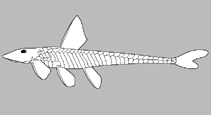
Dorsale stekels (totaal) : 2; Dorsale zachte stralen (totaal) : 7; Anale stekels: 1; Anale zachte stralen: 4. This species is distinguished from all its congeners, except H. affinis, H. punctatus, H. ancistroides, H. commersoni, by the following characters: teeth bifid (vs. spoon-shaped); dark spots on light background (vs. light spots on a dark background or not spotted); with 4 rough lateral ridges on flanks (vs. no strong ridges on flanks); lateral series plates 26-29 (vs. < 28 in several species, 31-32 in H. laplatae); differs from H. laplatae with 1-2 plates bordering posterior margin of supraoccipital bone (vs. 3-4); differs from H. affinis, H. punctatus, H. ancistroides by its inter-dorsal distance 14.7-20.4% in SL (vs. 18.9-21.0%) and with head depth 48.8-76.4% in HL (vs. 48.2-49.9%); differs from H. commersoni by having large lateral ridges with odontodes posteriorly inclined (vs. fine and with odontodes in all directions), strong lateral ridges in caudal peduncle (vs. weak), mid lateral ridge from 2nd or 3rd plate (vs. from first plate), adults (> 12 cm SL) with a very weak ridge on temporal plate (vs. strong ridge) (Ref. 121236).
Cross section: angular.
Facultative air-breathing in the genus (Ref. 126274); This species was collected on substrate mainly composed of sand, oxygenated waters (8.4-9.0 mg/l) with moderate current; water turbidity was 22.4-74.2 NTU., conductivity 567-1909 μS/cm, pH 7.6-8.3, and temperature 19.8-25.3°C (Ref. 121236). Feeds on organic material (detritus) on the bottom (Ref. 6868).
Levenscyclus en paargedrag
Maturiteit | Voortplanting | Paaien | Eieren | Fecunditeit | Larven
Cardoso, Y.P., F. Brancolini, L. Protogino, A. Paracampo, S. Bogan, P. Posadas and J.I. Montoya-Burgos, 2019. An integrated approach clarifies the cryptic diversity in Hypostomus Lacépède 1803 from the Lower La Plata Basin. Anais da Academia Brasileira de Ciéncias 91(2):e20180131: [1-25]. (Ref. 121236)
Status op de Rode Lijst van het IUCN (Ref. 130435: Version 2025-2 (Global))
Gevaar voor de mens
Harmless
Gebruik door de mens
Visserij: van geen belang
Tools
Speciale rapporten
Download XML
Internetbronnen
Schattingen op basis van modellen
Fylogenetische diversiteitsindex (Ref.
82804): PD
50 = 0.5000 [Uniqueness, from 0.5 = low to 2.0 = high].
Bayesian length-weight: a=0.01585 (0.00726 - 0.03460), b=2.95 (2.78 - 3.12), in cm total length, based on LWR estimates for this Genus-body shape (Ref.
93245).
Weerstandsvermogen (Ref.
120179): Gemiddeld, minimale populatieverdubbelingstijd 1,4-4,4 jaar (Preliminary K or Fecundity.).
Kwetsbaarheid van de visserij (Ref.
59153): Low vulnerability (25 of 100).
🛈