Classification / Noms
Noms communs | Synonymes | Catalog of Fishes(Genre, Espèce) | ITIS | CoL | WoRMS | Cloffa
>
Siluriformes (Catfishes) >
Callichthyidae (Callichthyid armored catfishes) > Corydoradinae
Etymology: knaacki: Named for Dr. Joachim Knaack, an amateur ichthyologist and aquarist who devoted over 60 years of his life for the study of South American catfishes, especially Corydoras. A genitive noun.
Eponymy: Joachim Knaack (1933–2012) was a German physician, biologist, amateur ichthyologist and aquarist, who devoted more than 60 years of his life to the study of South American catfishes, especially Corydoras. [...] (Ref. 128868), visit book page.
Environnement : milieu / zone climatique / profondeur / gamme de distribution
Écologie
; eau douce démersal. Tropical
South America: Río Madre de Dios basin, Peru.
Taille / Poids / Âge
Maturité: Lm ? range ? - ? cm
Max length : 4.0 cm SL mâle / non sexé; (Ref. 121196)
Description synthétique
Clés d'identification | Morphologie | Morphométrie
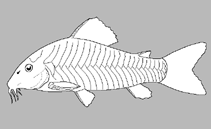
Épines dorsales (Total) : 2; Rayons mous dorsaux (Total) : 7 - 8; Rayons mous anaux: 7 - 9. Corydoras knaacki is distinguished from its congeners by having the following combination of characters: a longitudinal black stripe along midline of flank; short mesethmoid, with anterior portion smaller than 50% of the bone length; serrations on posterior margin of pectoral spine directed towards the tip of the spine; dorsal fin with the region of the first branched ray, including membrane, with black pigmentation, the remaining areas with irregular black blotches; lacking a vertically elongated black blotch across the eyes; snout with conspicuously rounded moderately-developed black spots; and ventral expansion of infraorbital 1 moderately developed (Ref. 121196).
Body shape (shape guide): fusiform / normal.
Facultative air-breathing (Ref. 126274)
Cycle de vie et comportement reproducteur
Maturité | Reproduction | Frai | Œufs | Fécondité | Larves
Tencatt, L.F.C. and H.-G. Evers, 2016. A new species of Corydoras Lacépède, 1803 (Siluriformes: Callichthyidae) from the río Madre de Dios basin, Peru. Neotrop. Ichthyol. 14(1) e150019:1-14. (Ref. 121196)
Statut dans la liste rouge de l'IUCN (Ref. 130435: Version 2025-2 (Global))
Menace pour l'homme
Harmless
Utilisations par l'homme
Outils
Articles particuliers
Télécharger en XML
Sources Internet
Estimations basées sur des modèles
Indice de diversité phylogénétique (Réf.
82804): PD
50 = 0.5000 [Uniqueness, from 0.5 = low to 2.0 = high].
Bayesian length-weight: a=0.01778 (0.00758 - 0.04173), b=3.02 (2.82 - 3.22), in cm total length, based on LWR estimates for this (Sub)family-body shape (Ref.
93245).
Niveau trophique (Réf.
69278): 3.0 ±0.4 se; based on size and trophs of closest relatives
Résilience (Réf.
120179): Haut, temps minimum de doublement de population inférieur à 15 mois (Preliminary K or Fecundity.).
Vulnérabilité de la pêche (Ref.
59153): Low vulnerability (10 of 100).
🛈