Entorno: milieu / zona climática / rango de profundidad / gama de distribución
Ecología
marino demersal; rango de profundidad 10 - 250 m (Ref. 109259). Tropical
Eastern Atlantic: Portugal to Ghana.
Tamaño / Peso / Edad
Madurez: Lm ? range ? - ? cm
Max length : 20.0 cm SL macho / no sexado; (Ref. 109259); common length : 15.0 cm SL macho / no sexado; (Ref. 109259)
Descripción breve
Claves de identificación | Morfología | Morfometría
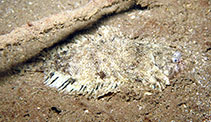
Radios blandos dorsales (total) : 50 - 58. This species is distingusihed by the following characters: body oval, stocky, laterally compressed; greatest depth in anterior one-third with moderate anterior and more gradual posterior taper beyond this point; head relatively large, broadly rounded anteriorly; short snout rounded; eyes separated by small, concave, interorbital space; mouth symphysis reaching vertical through middle of lower eye; ocular-side anterior nostril tubular, reaching beyond anterior margin of lower eye; blind-side anterior nostril tubular; D 50-58, fin's origin anterior to vertical through anterior margin of eyes; A 40-45; dorsal and anal fins are not connected to caudal peduncle; caudal peduncle very distinct; pectoral-fin rays 5-6 on ocular side, absent on blind side; scales trapezoid, very rough; pored lateral line scales 52-54, supratemporal branch of lateral line not distinct. Colour: ocular side is greyish or reddish brown with darker spots or irregular bands, the dorsal and anal fins with alternating series of 1 or 2 lightly pigmented and 4 to 6 darkly pigmented fin rays, the pectoral fin darker than body colour; blind side whitish (Ref. 109259).
Body shape (shape guide): short and / or deep; Cross section: flattened.
This demersal species is found on sand and mud bottoms on the continental shelf (10-250 m), and also occurring frequently near plant growth. Common length between 10 and 15 cm SL. Taken in by bottom trawls and shore seines. Marketed fresh in some countries, rejected in others (Ref. 109259).
Ciclo vital y comportamiento de apareamiento
Madurez | Reproducción | Puesta | Huevos | Fecundidad | Larva
Carpenter, K.E. and N. De Angelis (eds.), 2016. The living marine resources of the Eastern Central Atlantic. Vol. 4: Bony fishes part 2 (Perciformes to Tetradontiformes) and sea turtles. FAO Species Identification Guide for Fishery Purposes, Rome, FAO. pp. 2343-3124. (Ref. 109259)
Situación en la Lista Roja de la UICN (Ref. 130435: Version 2025-2 (Global))
Amenaza para el ser humano
Harmless
Usos humanos
Herramientas
Informes especiales
Descargar XML
Fuentes de Internet
Estimaciones basadas en modelos
Índice de diversidad filogenética (Referencia
82804): PD
50 = 0.6250 [Uniqueness, from 0.5 = low to 2.0 = high].
Bayesian length-weight: a=0.01072 (0.00621 - 0.01850), b=3.10 (2.95 - 3.25), in cm total length, based on LWR estimates for this species & (Sub)family-body (Ref.
93245).
Nivel trófico (Referencia
69278): 3.5 ±0.5 se; based on size and trophs of closest relatives
Generation time: 1.6 ( na - na) years. Estimated as median ln(3)/K based on 1
growth studies.
Resiliencia (Referencia
120179): Medio, población duplicada en un tiempo mínimo de 1.4-4.4 años (K=0.2).
Vulnerabilidad pesquera (Ref.
59153): Low vulnerability (14 of 100).
🛈