>
Blenniiformes (Blennies) >
Tripterygiidae (Triplefin blennies) > Tripterygiinae
Etymology: Enneanectes: Greek, ennea = nine times + Greek, nektos = that swimms (Ref. 45335); flavus: Name from Latin ' lavus' for yellow, referring to the bright yellow color of the mature male; a masculine nominative singular adjective.
Environnement : milieu / zone climatique / profondeur / gamme de distribution
Écologie
marin récifal; profondeur 0 - 3 m (Ref. 119367). Tropical
Distribution
Territoires | Zones FAO | Écosystèmes | Occurrences | Carte par point | Introductions | Faunafri
Western Atlantiic: limited to northeastern Venezuela and Tobago; probably overlapping with E. matador in St. Vincent.
Taille / Poids / Âge
Maturité: Lm ? range ? - ? cm
Max length : 2.8 cm SL mâle / non sexé; (Ref. 119367); 2.5 cm SL (female)
Description synthétique
Clés d'identification | Morphologie | Morphométrie
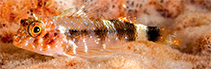
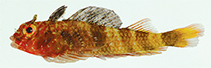
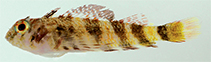
Épines dorsales (Total) : 15; Rayons mous dorsaux (Total) : 7 - 8; Épines anales: 2; Rayons mous anaux: 16 - 17. The species is distinguished by having the following characters: unscaled-abdomen, 3 scale rows above posterior pored lateral line; a very short blunt snout, spiny preorbital flange; pored lateral-line scales mode of 14 or 15; broadly black-speckled second dorsal fin in adults, especially males (shared only with E. matador). Colour: mature adults with black spinous dorsal fins; yellowish rear body and tail, especially in mature males; melanophores extending from last body bar onto proximal third of caudal fin (unless obscured by bright yellow); interspace between third and fourth body bars half or less of interspace between fourth and fifth body bars, the last dark body bar usually extending onto the basal third of the caudal fin; three dark blotches along anal fin (except uniformly dusky in mature males); fresh and especially preserved specimens show two large black blotches on each side behind opercular flap, within a usually narrowly split first body bar (Ref. 119367).
Body shape (shape guide): elongated; Cross section: oval.
Cycle de vie et comportement reproducteur
Maturité | Reproduction | Frai | Œufs | Fécondité | Larves
Victor, B.C., 2019. Enneanectes flavus, a new endemic species of triplefin blenny from the southeastern Caribbean (Teleostei: Tripterygiidae). J. Ocean Sci. Found. 32:1-16. (Ref. 119367)
Statut dans la liste rouge de l'IUCN (Ref. 130435: Version 2025-2 (Global))
Menace pour l'homme
Harmless
Utilisations par l'homme
Pêcheries: sans intérêt
Outils
Articles particuliers
Télécharger en XML
Sources Internet
Estimations basées sur des modèles
Indice de diversité phylogénétique (Réf.
82804): PD
50 = 0.5000 [Uniqueness, from 0.5 = low to 2.0 = high].
Bayesian length-weight: a=0.00617 (0.00290 - 0.01310), b=3.04 (2.86 - 3.22), in cm total length, based on LWR estimates for this (Sub)family-body shape (Ref.
93245).
Niveau trophique (Réf.
69278): 2.8 ±0.3 se; based on size and trophs of closest relatives
Résilience (Réf.
120179): Haut, temps minimum de doublement de population inférieur à 15 mois (Preliminary K or Fecundity.).
Vulnérabilité de la pêche (Ref.
59153): Low vulnerability (10 of 100).
🛈