Classification / Noms
Noms communs | Synonymes | Catalog of Fishes(Genre, Espèce) | ITIS | CoL | WoRMS | Cloffa
>
Cichliformes (Cichlids, convict blennies) >
Cichlidae (Cichlids) > Pseudocrenilabrinae
Etymology: Labeotropheus: Latin, labeo = one who has large lips + Greek, tropaion = defeat, a memorial of a fighting war, trophy; because of their specialized teeth were such an obvious feeding adaptation (Ref. 45335); simoneae: This species is named in honour of Simone Josephine Pauers, daughter of author Michael J. Pauers, whose rosy cheeks reminds him of the bright orange opercula of the males of this species (Ref. 111073).
Eponymy: Simone Josephine Pauers is the daughter of the author American zoologist Michael J Pauers. As he wrote, she is his: “…beautiful daughter, Simone Josephine Pauers, whose rosy cheeks remind me of the bright orange opercula of the males of this species.” (Ref. 128868), visit book page.
Environnement : milieu / zone climatique / profondeur / gamme de distribution
Écologie
; eau douce benthopélagique. Tropical
Africa: Lake Malawi, near Katale Island in Malawi (Ref. 111073).
Taille / Poids / Âge
Maturité: Lm ? range ? - ? cm
Max length : 11.0 cm mâle / non sexé; (Ref. 111073)
Description synthétique
Clés d'identification | Morphologie | Morphométrie
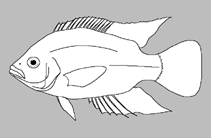
Épines dorsales (Total) : 17 - 19; Rayons mous dorsaux (Total) : 8 - 9; Épines anales: 3; Rayons mous anaux: 7 - 8. Diagnosis: All diagnostic characteristics of Labeotropheus present: steeply sloping head; broad, fleshy snout; wide jaws with retrognathous lower jaw; mouth is inferior and subterminal (Ref. 111073). Labeotropheus simoneae differs from all other species of Labeotropheus in having extensive orange colouration on the operculum in males, vs. blue in L. fuelleborni, L. trewavasae and L. chlorosiglos; although the male nuptial colour pattern is extremely similar to that of L. chlorosiglos, the presence of the orange pigmentation on the operculum is a clear difference between L. simoneae and L. chlorosiglos (Ref. 111073). It differs from the deeper-bodied Labeotropheus primarily based on a shallow, slender body, body depth 28.4-30.8% of standard length vs. 35.1-41.6% in L. fuelleborni and 31.9-34.7% in L. chlorosiglos, and head, head depth 88.0-98.8% of head length vs. 101.2-108.9% in L. fuelleborni and 99.3-108.0% in L. chlorosiglos, as well as a shorter distance from the origin of the dorsal fin to the origin of the anal fin, 47.1-50.5% of standard length in L. simoneae vs. 51.3-54.6% in L. chlorosiglos and 52.5-55.5% in L. fuelleborni, and a shorter distance between insertion of the dorsal fin and the origin of the anal fin, 27.4-28.5% of standard length in L. simoneae vs. 29.1-33.2% in L. chlorosiglos and 29.6-31.7% in L. fuelleborni (Ref. 111073). It differs from L. trewavasae in the number of neuromasts present in the infraorbital pores, 27-29 vs. 8-25 in L. trewavasae, and has generally larger pectoral fins, 21.9-26.3% of standard length vs. 20.8-23.9% in L. trewavasae, greater distance between the insertion of the dorsal fin and the insertion of the anal fin, 14.6-16.0% of standard length vs. 12.7-15.5% in L. trewavasae, deeper preorbital depth, 24.0-28.5% of head length vs. 21.2-27.6% in L. trewavasae, longer and wider lower jaw, 27.4-36.3% of head length vs. 23.0-32.7% and 41.2-47.8% of head length vs. 34.7-43.9% respectively, and a greater interorbital width, 34.6-42.7% of head length vs. 29.6-40.5% (Ref. 111073).
Body shape (shape guide): fusiform / normal.
Cycle de vie et comportement reproducteur
Maturité | Reproduction | Frai | Œufs | Fécondité | Larves
Pauers, M.J., 2016. Two new and remarkably similarly colored species of Labeotropheus (Perciformes: Cichlidae) from Lake Malawi, Africa. Copeia 104(3):628-638. (Ref. 111073)
Statut dans la liste rouge de l'IUCN (Ref. 130435: Version 2025-2 (Global))
Menace pour l'homme
Harmless
Utilisations par l'homme
Pêcheries: sans intérêt
Outils
Articles particuliers
Télécharger en XML
Sources Internet
Estimations basées sur des modèles
Indice de diversité phylogénétique (Réf.
82804): PD
50 = 0.5005 [Uniqueness, from 0.5 = low to 2.0 = high].
Bayesian length-weight: a=0.00389 (0.00180 - 0.00842), b=3.12 (2.94 - 3.30), in cm total length, based on all LWR estimates for this body shape (Ref.
93245).
Niveau trophique (Réf.
69278): 3.4 ±0.4 se; based on size and trophs of closest relatives
Résilience (Réf.
120179): Haut, temps minimum de doublement de population inférieur à 15 mois (Preliminary K or Fecundity.).
Vulnérabilité de la pêche (Ref.
59153): Low vulnerability (10 of 100).
🛈