>
Cichliformes (Cichlids, convict blennies) >
Cichlidae (Cichlids) > Pseudocrenilabrinae
Etymology: Pseudocrenilabrus: Greek, pseudes = false + Latin, crenulatus = cut + Latin, labrum = lip (Ref. 45335).
Umwelt: Milieu / Klimazone / Tiefenbereich / Verbreitungsgebiet
Ökologie
; süßwasser demersal; pH range: 6.8 - 7.2; dH range: 10 - 14; standorttreu. Tropical; 20°C - 24°C (Ref. 13371); 33°N - 5°S
Africa: Nile River system, Lake Albert, Semliki River, Lakes Victoria and Kyoga, Malawa and Aswa Rivers, Lake George, Lake Nabugabo, swampy lakes Kachira, Kijanebalola and Nakavali which lie between Lakes Edward and Victora; and rivers and lakes of Uganda including the Albert Lake drainage. Absent from Lake Turkana. Previously, two subspecies were recognized: Pseudocrenilabrus multicolor victoriae and Pseudocrenilabrus multicolor multicolor.
Größe / Gewicht / Alter
Geschlechtsreife: Lm ? range ? - ? cm
Max length : 8.0 cm TL Männchen/unbestimmt; (Ref. 4967)
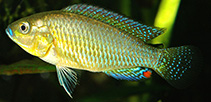
Caudal fin rounded.
Body shape (shape guide): fusiform / normal; Cross section: oval.
Inhabits streams and ponds (Ref. 4967). Feeds on worms, crustaceans, insects (Ref. 7020), algae, vegetable fragments and small fish (Ref. 28714). Ovophilic, agamous maternal mouthbrooder; no pair-bonding takes place (Ref. 52307).
Lebenszyklus und Paarungsverhalten
Geschlechtsreife | Fortpflanzung | Ablaichen | Eier | Fruchtbarkeit | Larven
Females takes the brood into her mouth and takes care of the young.
Skelton, P.H., 1991. Pseudocrenilabrus. p. 394-398. In J. Daget, J.-P. Gosse, G.G. Teugels and D.F.E. Thys van den Audenaerde (eds.) Check-list of the freshwater fishes of Africa (CLOFFA). ISNB, Brussels; MRAC, Tervuren; and ORSTOM, Paris. Vol. 4. (Ref. 5682)
IUCN Rote Liste Status (Ref. 130435: Version 2025-2 (Global))
Bedrohung für Menschen
Harmless
Nutzung durch Menschen
Aquarium: Kommerziell
Tools
Zusatzinformationen
Download XML
Internet Quellen
Schätzungen auf der Grundlage von Modellen
Phylogenetischer Diversitätsindex (Ref.
82804): PD
50 = 0.5625 [Uniqueness, from 0.5 = low to 2.0 = high].
Bayesian length-weight: a=0.01445 (0.00671 - 0.03113), b=2.99 (2.82 - 3.16), in cm total length, based on LWR estimates for this (Sub)family-body shape (Ref.
93245).
Trophische Ebene (Ref.
69278): 3.0 ±0.40 se; based on food items.
Widerstandsfähigkeit (Ref.
120179): hoch, Verdopplung der Population dauert weniger als 15 Monate. (tm<1).
Anfälligkeit der Fischerei (Ref.
59153): Low vulnerability (10 of 100).
🛈